Friday, February 6, 2009

THEORY OF MIND


I can see you. You can see

Me. I can see you

Can see me. You can see

I can see you. I can see

You can see me

Seeing you. I can see me

In you. I can see you

In me. I can see you

Seeing you in me, seeing

Me in you. You can see

Me seeing me in you,

Seeing you in me. You and me,

We can see me and you.

I can see you can see. You. Me.


Newsflash: University Hostile to Independent Thought and Radical Action

A friend of mine posted this story on Facebook today. I'm totally with this guy. I know grades poisoned my university experience. And not because I got bad ones. Because I got straight A's and had to keep those grades up to keep my scholarships and I had to keep my scholarships to keep out of debt, which I had to keep out of to keep from becoming indentured indefinitely to an economic agenda I'm none too fond of. Rock. Hard Place. So I chose courses strategically, picking the occasional bird course to lighten the load, rather than taking something that might interest and challenge me more and writing papers I knew would succeed rather than pushing into riskier topics and approaches.

Most profs and administrators are so conditioned by the grading system that they don't even think about this sort of thing. When I was choosing courses for my fourth year at university (a year I was only enrolled in for a piece of paper, not for education per se), I signed up for a couple of 2nd year courses in my major. Even tho the department's guidelines said I could take these courses because I'd fulfilled all the specific requirements for an English degree, I was called in to see the department chair. He advised me not to take those courses because they'd be too easy for me. I told him that was part of why I was taking them. He looked at me like I had two heads. I guess that kind of pragmatism doesn't come naturally to an academic. He had no concept that without grades, those kinds of decisions wouldn't be made.

I hope Denis Rancourt prevails. He sounds like a damn good teacher who, unlike so many profs, has actually given a lot of thought to pedagogy. Which you can see for yourself in this interview.

Charles Bruce

Just encountered this lovely reading of Charles Bruce's "Back Road Farm," by someone named David Kosub. Glad to see another Bruce Poem featured at Arc. The more of this that happens, the more likely his exceptionally fine poems will stay alive. I'm still waiting anxiously for the new selected Bruce that's supposed to be published by Signal Editions. The last book of Bruce poems was 1985. Almost a quarter century now. High time for the new one.

Here's me reading Bruce's "Nova Scotia Fish Hut":


UPDATE: Carmine Starnino has posted about the Kosub essay and provided a link to this virtual chapbook of Bruce's poems. Sounds like the Bruce book I'm looking forward to will be out in a couple of years, 40 years after his death.

Thursday, February 5, 2009

CNQ 75


The latest number of CNQ arrived in my box today. This is a special issue edited by Carmine Starnino, featuring soothsaying essays on various cultural topics by different writers. Haven't had a chance to dig into it yet. Looking forward to doing so soon.

In my section of the mag, there's some very good stuff, including

  • Jason Guriel on Nick Thran, JD Black and Christopher Patton's debut collections
  • Nick Thran on Jason Guriel and David McGimpsey's mass media-inspired collections
  • Alessandro Porco on a couple of slippery poets, Kevin Connolly and Walid Bitar
  • Jim Pollock on the black and white magics of Jeffery Donaldson
  • Steven W. Beattie on the Giller list
  • Lyle Neff on David W. McFadden's selected
  • Martin Wallace on WJ Keith's cultural conservatism
  • Yours Truly on first collections by Suzanne Buffam and Pino Coluccio
The last on that list is a bit of a long story. I first wrote the review for The Antigonish Review in 2005. Several issues went by and no review. Then I saw they published a review of a book published in 2006 and asked if I could withdraw the review. I'm the first to admit I'm not the most organized of reviews editors, but that was just a bit too much. So it was homeless for a while till I gave it to Dan Wells. He was going to post it on the CNQ website, but then Carmine wanted it for the issue he was editing, so voila. Never too late for an in-depth review of good books.

But the highlight of my section, if I'm allowed to pick favourites, is Pollock's review essay of Donaldson's oeuvre to-date. James has emerged in the last couple of years as one of the few truly top-notch Canadian poetry critics. His criticism is very precise and meticulously argued, but never dryly dispassionate. An earlier part of this essay was published at Contemporary Poetry Review a while ago. The updated piece takes into account Donaldson's new book, the outstanding Palilalia, as well.

There are also four poems each from a couple of poet-critics who are no slouches themselves, Jason Guriel and Mark Callanan. After precociously strong debuts, they've both got new books coming out soon, I do believe, which I'm looking forward to seeing. An awful lot of good-looking poetry collections on the horizon.

An Event-ful day

Just learned that my poem "Ego Sum" will be published in a forthcoming issue of Event magazine. Very nice. I find Event one of the most interestingly eclectic poetry sections of Canadian mags. This is a poem I can't imagine too many other magazines printing because of its weirdness (39 lines of anaphoric falling rhyme). It was certainly the most oddball poem I sent them. And it's one that I'm particularly fond of, so I'm glad it's found a halfway house.

Lettres miniscules

Could this be the next frontier for Christian Bok?

Wednesday, February 4, 2009

Les Mis-érables

Ooooh, wasn't that a clever postmodern pun!

So, apparently the average artist in Canada is "almost poor." (Anyone else wondering how much it cost our esteemed institutions to come to this earth-shattering discovery?) That is, if you only consider the income they make from their artsy work and ignore the money they make from their fartsy work.

But "In 2005, 42 per cent of artists said they took part-time jobs, compared with 22 per cent for the overall labour force." Newsflash: the other 22% didn't "take" a part-time job; many of them probably had no choice and had to "take" several such jobs to pay for rent, food, transportation and such. These are the people we might know as actually poor. I hear their hearts are bleeding for the almost-poor artists.

Another thing: how many artists at or below the poverty line (set for a single person in a city of 500,000+) are actually single people in cities of 500,000? What kind of dough do their spouses make? (Full disclosure: my mother is a full-time artisan whose net income is well below the single-person-in-a-city line. She lives in the country in a province with fewer than 200,000 people. My father is a retired deputy minister. My mother used to be federal civil servant. She much prefers being a poor artisan.) Is a tenured professor who teaches a subject related to his or her artistic professor an artist or an academic? It would seem the latter, since the "aristocracy" is identified as being comprised of "producers/directors/choreographers." This skews the numbers something fierce, considering the number of writers who work for university English and/or CW departments.

Interesting to note that 42% of artists are self-employed. At least we know who's exploiting those poor fuckers.

My favourite part:

What makes the situation even more distressing is that artist earnings have been decreasing since 1990 – a decline likely to intensify over the next two years. While average earnings for the overall labour force rose by almost 10 per cent from 1990 to 2005, artists experienced a slide of 11 per cent – to $22,731 from $25,433 – at the same time as the cultural-sector work force tripled in size. Actors experienced the sharpest decline in average earnings among artists, dropping 34 per cent to about $18,000 in 2005.


It takes a really piss-poor grasp of maths--something for which artists are notorious--not to get this. I think it's safe to assume that the non-cultural workforce did not triple in the 15 years between 1990 and 2005. If it did, boy would the average wage take a hit! That the cultural workforce did triple, and that--recall--42 per cent of that workforce is self-employed, and that the wages dropped--all this might just signify, oh, I don't know .... that there are too many artists for the amount of money available!!! Y'know what, I bet it's those foreign artists, you know the ones, the "exiles" from Bosnia and Iran, coming here and taking our arts dollars. Those bastards.

Finally, what the survey doesn't even pretend to address, because it's not quantifiable: shitty artists don't deserve to earn a living by their art. Many do anyway, but that's another story.

(from CanCult)

Assholes and Idiots

Having been in and out of the service industry for the past 18 years--wow, that's one long low point--I've encountered my fair share of each of these types of obnoxious customers. Or "guests" as we call 'em on board the train.


I'd add "The Nic Fitter" to the list as a transportation specific problem customer. This is the asshole who asks twenty-five times when the next smoke stop is, if you'll wake him up when we get there, constantly pulls his pack out of his pocket and stares at it longingly, tries to sneak a smoke in a washroom or vestibule and then pretends he didn't know he wasn't allowed.


And a somewhat less job-specific jerk is "The Raging Drunk." On the train, this is someone who brings on their own booze, because most train staff--unless they're gettin' real well tipped--won't serve a person till they're in a state of incoherent incapacity. Some of these drunks are Jekyll and Hyde types, sweet as pie when they get on the train, unable to walk and talk or abusive six hours later.


The best thing about the train is that, whether it's the Nic Fitter, the Drunk or the Ticking Timebomb, I have the option of removing them before their stop--and have exercised that option several times. There aren't too many jobs where you can get revenge on the asshole customer. The other categories I pretty much just have to put up with. I actually have to court "The Soapbox" in one of my train jobs. But I also make better coin than most service industry pros, so I shouldn't complain too much.


Sunday, February 1, 2009

Upcoming Reading

TWS
READING
SERIES

AT BLENZ
COFFEE SHOP
508 HASTINGS (AT
RICHARDS) VANCOUVER

CREATIVE FICTION
NONFICTION POETRY IN
THE THEME OF
LOVE

FRIDAY, FEB. 13, 2009
7:00 TO 9:00 PM


GUEST POET JENNICA HARPER is a screenwriter and poet whose books include The Octopus and OtherPoems (Signature Editions, 2006), and What It Feels Like for a Girl (Anvil Press, 2008). Her poems have been shortlisted for the CBC Literary Awards and featured on Vancouver buses as part of the Poetry in Transit project. When not working on poetry, she's teaching a UBC course called "Introduction to Writing for New Media" and adapting a kids' comic book into an animated feature film.


GUEST WRITER ZACHARIAH WELLS was born and raised on PEI and has since lived all over Canada. He is the author of Unsettled, a collection of poems distilled from his time as an airline cargo hand in Nunavut, the editor of Jailbreaks: 99 Canadian Sonnets, and co-author, with Rachel Lebowitz, of Anything But Hank!, a children's picture book. Wells is the reviews editor for Canadian Notes & Queries magazine, writes freelance book reviews and works seasonally for Via Rail as an onboard train attendant. He has a new collection of poems forthcoming in the fall and a collection of essays and reviews for 2010.

for more information visit www.thewritersstudio.ca

MIRACLE


I had the freakiest shit today—

no, wait, don’t walk away,

I’m not the sort of sicko dude

to wax weird about lewd

pervy fetish stuff, this is

something heavier than shits and pisses,

alright? Alright, so there it was: one

solitary turd, the sort of bun

I always hope for,

no mess clean-up, walk away—but just before

I put my finger to the lever,

I realize it's a nugget unlike any I’ve ever

seen: see, it was the same shape, exactly,

as a human brain: two perfectly

symmetric hemispheres, the curvy folds

and involutions. I was totally bowled

over—I mean, it blew my mind

that my sphincter could extrude

such an intricately lined

scale model out of shit—

Eh? What do you think I did with it—

I sent it down the fucking drain.

I told you, I’m not that kind of dude—

brain, or no brain.

I'ts your hamster. And it's not breathing.

I aspire to this level of complaint.

Saturday, January 31, 2009

Thursday, January 29, 2009

On Masculinist Aggression

Dale (last name?) addresses a pet peeve of mine: the anti-intellectual shut-up tactic of saying that a contrary point of view expressed by a man is an act of aggression, bullying, attempted intimidation, what have you. In my experience, this is usually a very thinly veiled way of sneaking out the back door once someone has called bullshit on a patently bullshitty statement. But that's just my aggressive masculinist perspective, eh.

(from Squandermania)

Wednesday, January 28, 2009

Knee-Slappers

An hilarious list of mock-academic essay titles. The next step is to find out just how many of them have been written...

Riddle Fence Wants You!

The good folks at Riddle Fence, who are publishing a couple of my poems in the near future, are looking for submissions for the less-near future. Why not send 'em somepin?

CALL FOR SUBMISSIONS

Call for Submissions to Riddle Fence Issue #4

For Immediate Release
January 19, 2009
Kill Date: March 2, 2009

Riddle Fence, a Newfoundland-based journal of arts & culture, is currently accepting submissions for its fourth issue.

We are currently considering previously unpublished submissions of poetry, fiction, creative non-fiction, and reviews. Please send no more than 3-4 poems or 1 piece of prose, maximum 5000 words in length. Payment is $30 per printed page (prose and poetry) for first Canadian serial rights, plus a copy of the issue in which your work appears.

What are we looking for? What is anyone looking for: brilliance, innovation, that certain je ne sais quoi de sage-like insight that will blow away the doldrums and give our lives greater meaning.

The deadline for submissions is March 2, 2009.

Please note, due to the extraordinary volume of email submissions received for previous issues, we will no longer be considering electronic submissions. We apologize for any inconvenience this may cause. Submissions may be made by regular post (please include a self-addressed stamped envelope or sufficient IRC postage in the case of submissions from outside Canada):

Riddle Fence
PO Box 7092
St. John's, NL
A1E 3Y3

For more information, contact us by email at riddlefence@gmail.com, or visit our website: www.riddlefence.com

Canadian Poetry--the Molson Ad Campaign Version

Molly Peacock has been blogging about the new Best Canadian Poetry anthology, over at the Best American Poetry blog. If I haven't said it here before, I think it's a remarkably strong anthology. And I'm glad to see the involvement in it of someone like Peacock, who straddles the US/Canadian border. I'm a bit dismayed to see her making broadstroke generalisations about Canadian verse over at the blog, however. I always find those kind of synthesizing analyses, whatever kernel of truth they might contain, obscure far more than they reveal and do nothing so much as perpetuate a prejudice. Should I be Canadian now and say, "But that's just my opinion"?

Tuesday, January 27, 2009

Probably the closest I'll ever get to being in Poetry

Jason Guriel, whipsmart poet and critic who's been blogging for Harriet, has written up Evie Christie's Desk Space blog, and used my messy office as an illustration. If I'd known company was coming, I'd've cleaned the place up. Or not. I'm moving in a couple of months anyway.

Souvankham Thammavongsa


I've been reading Souvankham Thammavongsa's books in preparation for a review. I'm digging her work far more than I expected to. She is the quintessential minimalist and my own predilections tend to be for the maximalist. But what she's doing is so damn precise and ruthless. I wasn't surprised to find, in various interviews, that she's very smart and has uncommonly keen insights into the hows and whys of her work.

Thought I'd share some of the fruits of my internet trawling. Below are choice quotations with links to the interviews whence they came. Below those, various links to her work in various formats on the web. Enjoy.

I don’t really like poets. They are awfully boring and not honest about anything at all. [From an interview in The New Quarterly, which is, alas, not available online]

*

*

Choosing favourites has less to do with fairness and more to do with pride. I think you should be proud of what you make. You should have favourites. Favourites are the result of having a standard, a sense of what you want your work to be. I am skeptical of writers who love everything they write. There’s something wrong [t]here. When I like a poem, it is the same as a carpenter knowing and seeing how well a table is built. I know and see all the things I did right. It feels sturdy and no matter what anyone does to it or says of it, it doesn’t wobble.

*


*

ST reading at the Test Series

ST's austere desk space

ST's even more austere blog

Short talk about self-publication given by ST

Two poems of ST's (PDF)

Review of a performance piece by ST and others, with a link to a recording

Video adaptation of an ST poem, by Kat Burns

Another video poem

CBC audio interview with ST


Monday, January 26, 2009

A Minor Disappointment

Last year, Rachel and I both applied for a residency at Berton House in Dawson City, Yukon. Today, we learned that, along with 74 other applicants, we didn't make the cut. I was glad to see, however, that Pasha Malla and Jeramy Dodds, talented and charming men both, did. Congrats, fellas.

WRITERS’ TRUST TO SEND AUTHORS NORTH:

Upcoming Writers-in-Residence of Berton House Announced

January 26, 2009 – The Writers’ Trust of Canada has announced the four writers that will be writers-in-residence at the Berton House Writers’ Retreat during the 2009-10 year. Each writer will travel to Dawson City, Yukon, to live in the childhood home of Pierre Berton for a three-month period.

The writers selected are:

Pasha Malla (July to September 2009)

Born in St. John's, Newfoundland, raised in London, Ontario, and now living in New York City, Malla’s first collection of short stories, The Withdrawl Method, was published in 2008 and appeared on the Scotiabank Giller Prize longlist. He is currently working on his first novel.

Linda Goyette (October to December 2009)

An award-winning newspaper writer and editor, Goyette is a past recipient of the Atkinson Fellowship in Public Policy and Grant MacEwan Author’s Award. She lives in Edmonton and is working on a non-fiction book exploring the evolving nature of childhood in northwestern Canada.

Mylène Gilbert-Dumas (January to March 2010)

A French Canadian writer, Gilbert-Dumas has published award winning historical and science fiction novels for young adult readers. She recently published Lili Klondike, the first of a three-part series on the Klondike Gold Rush. She lives in Sherbrooke, Quebec.

Jeramy Dodds (April to June 2010)

The winner of the 2006 Bronwen Wallace Memorial Award, Dodds lives in Fredericton, New Brunswick. His first collection of poems, Crabwise to the Hounds, was published last year. He is working on a translation of Poetic Edda from Norse / Icelandic to English.

Eighty applications were received from writers wishing to be part of the program. Applications were assessed by a three-member committee comprised of Dawson City-based young adult novelist Joanne Bell, and two past writers-in-residence, playwright C.E. Gatchalian and novelist Russell Smith.

To date forty-five writers have spent time at Berton House since its inception in 1996. Writers each receive a monthly honorarium, perform public readings, and interact with community residents. To be eligible for the program, applicants must be professional Canadian writers who have published at least one book and are established in any creative literary discipline (fiction, non-fiction, poetry, play/screenwriting, journalism).

The program is funded through an annual fundraising gala organized by the Berton House Writers’ Retreat Society and chaired by Elsa Franklin. Additional support for the retreat is provided by the Canada Council for the Arts, Dawson City Community Library, and Klondike Visitors Association. The Writers’ Trust is also grateful for support received from Aeroplan, the City of Dawson, Random House of Canada, and the Whitehorse Public Library.

For more information visit bertonhouse.ca


Ottawater

Three poems of mine have just been published in the online PDF magazine, Ottawater, dedicated to the writing of Ottawa residents, past and present. The first two poems (starting on page 118 of the mag) are Haligonian satires based loosely on Juvenal's Roman satires. If memory serves, I wrote them in the summer of 2005. I thought I might do a longer sequence of them, but my attention span got the better of me after three. The expansive, discursive voice in them is far from something that comes naturally to me when writing verse, so I consider them experiments. Thanks to Robert for publishing them.

Sunday, January 25, 2009


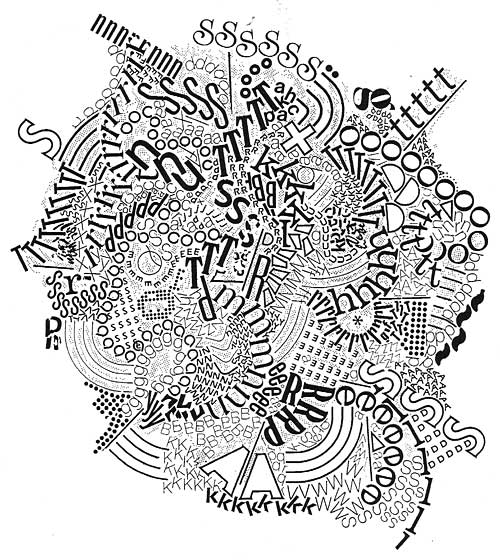
There's a lively discussion about visual poetry--more specifically about criticism of visual poetry or lack thereof, perceived or actual--going on over at the Harriet blog.

For my part, I've long wondered what substantive difference, if any, exists between a certain strain of typographical poetry and typographical logos created by graphic designers. What, for instance makes the image above not a poem and the image below a poem?


They're obviously different, but it's a difference of degree more than a difference of kind, isn't it? Aren't they both, fundamentally, typographical collage?

And how about this famous image:


Why is this a painting and not a visual poem?

I have a friend who is a visual artist. A couple of her works in progress are 1) a "shapetionary," or a dictionary that organizes objects not according to alphabetical order but according to their shape (e.g. a pineapple would be found in the same neighbourhood as a hand grenade) and 2) cutting all the periods out of certain books and arranging them as a collage. I've talked to her about both these projects and never once has she used the term visual poetry. Is she practicing it without being aware of it? Or is visual poetry--to be precise, most forms of it--more a visual than a lexical art form? Is the terminology useful?

The strawman figure defensively cut by champions of vispo is that of the reactionary philistine who stamps his feet and insists vehemently that what they do isn't Poetry. I know there are some out there who fit that profile, but then there are others who don't feel the need to defend Poetry from the barbarians--it needs no defending--but who wonder if the use of the terms "poetry" and "poem" don't frame this work in an unproductively imprecise manner. I'd say I'm one of those people. Personally, I can't say I'd classify much of the vispo I've seen as poetry, but as visual art. Which is a different thing altogether from saying it isn't Poetry.

The distinction isn't original, but it's one dealt with particularly eloquently by Robert Bringhurst--who happens to be a world-renowned typographer as well as a poet and probably has invested more time thinking about the "solid form of language" than the vast majority of soi-disant visual poets--in his recent collections of talks and essays. I think the following passage is analogically a propos:

Still, I want to know whether "philosophical poetry" is a useful term ... I suppose the attempt at a "philosophical poem" could fail tactically in either one of two ways, or in both. It could fail to yield poetry, in which case what remained might or might not still be philosophy. Or it could fail to be "philosophical," in which case what remained might or might not prove to be poetry of some other kind.


If the vast majority of visual poems fail to be Poetry, then, truly, they are no different from the vast majority of lineated text-based poems. If they fail to be Art, then they are no different from the vast majority of paintings, drawings and collages. Which is one reason why I don't call myself a poet and my uncle, who is a painter of no small accomplishment, doesn't call himself an artist.

Review online

My review of Tim Bowling's latest collection, The Book Collector, is now up on the Quill & Quire site.

Saturday, January 24, 2009

Elizabeth Bachinsky


An interview with my pal Elizabeth "Biz" (probably only to me) Bachinsky, in which she answers a couple of awkward questions with grace. Really looking forward to the new collection (and digging the cover design).

My Impersonation of Elizabeth Alexander

Friday, January 23, 2009

Ron Silliman is

busted!

Daniel F. Bradley is

unimpressed.

And I can hardly blame him.

Wednesday, January 21, 2009

Dionne Brand reads at UBC

I'm off to Greene College in a couple of hours to see Dionne Brand read. I've never heard her read before, so I'm looking forward to it. I'll see if I can bootleg a tape for y'all.

UPDATE: I've decided to bail. The temperature's near freezing and the roads are damp, so it's not safe for motorcycling and it's too damn far for transit. For my liking.

Friends or Foes

"Contemporary writers may generally be divided into two classes - one's friends or one's foes. Of the first we are compelled to think too well, and of the last we are disposed to think too ill, to receive much genuine pleasure from the perusal, or to judge fairly, of the merits of either." -- William Hazlitt

(Swiped from Squandermania)

Tuesday, January 20, 2009

Surprise, Surprise

Another article in the new Quill & Quire tells us that the mandatory Cancon for English classes in BC is making little to no difference in what gets taught. I wonder who said that would happen...

Here's a deal: if you're a BC English teacher and you want to teach a book I've written or edited, I'll donate half the copies you need and sell the other half at cost (40% discount from cover price). Not all at once now.

Oy, what a crappy poem

And an even worse reading. What's with the e-qual em-pha-sis on ev-er-y syl-la-ble? We speak a stress-timed language, fer christ's sake! Contrasted to the speeches and speaking of Obama and the preacher who delivered the benediction, Elizabeth Alexander looked worse yet. Would have been interesting to see what, say, Martin Espada would have done with such a commission...

UPDATE: A pretty incisive critique of just what's substandard about Alexander's poem.

UPDATE 2: Adam Kirsch on why Alexander's poem sucks. Which seems another good argument for someone like Espada, someone who is not an establishment figure, someone who actually has a lot of firsthand experience of disenfranchisement, who has lived in Hell's Kitchen instead of just knowing about/having ancestors who picked cotton. But let's face it, Obama's way more about assimilation than protest. As such, Alexander was, as Kirsch puts it, a "too perfect" choice.


Monday, January 19, 2009

Post-Launch Coverage


Rachel just found this cool little story about our Halifax launch of Anything But Hank! Nice.

More Bullshit and Lies

I picked up the latest issue of Quill & Quire yesterday, in which there is a little piece called "Canlit award follies: the last 10 years." Apparently, in 2007, "Author and critic Sarah Ellis is asked to leave the GG jury for children's literature (text). The rationale is that having reviewed some of the books under consideration, she, er, probably has opinions about them." Wow, who knew that the Canada Council had such stringent guidelines against conflict of interest? Apparently, they prefer to have jurors who haven't read the books at all, so that they can make a perfectly unbiased decision. Which must be why they replaced Christian Bok with Cyril Dabydeen at the last minute a couple of years ago. The Council is to be congratulated for the consistency of their ethical rectitude.

Sunday, January 18, 2009

Margaret (Midge) Douglas (nee Wheeler): 1924-2009


After a very long illness, my maternal grandmother, the last of my grandparents, died today in a palliative care home in Charlottetown. I wasn't especially close to her--all of my life, we lived in different provinces--and we've been anticipating this a long time, but it's a sad day. Her illness was epic, in large part because her constitution was so strong and she had, up until her last days, such a powerful will to live. Doctors were at a loss to explain how she survived as long as she did. As a consequence, she suffered not only from her disease, but--often worse--from the treatments she was always up for trying, no matter how taxing they were and how slim the chances of them helping her. She was staying at home, just up the hill from my parents, until last month, when a rapid downturn led to her hospitalization. A few days before this happened, fortunately, she had the opportunity to meet our son Kaleb, her only biological great-grandchild. She said that holding him she had a feeling of continuity. She is survived by my mother, Lynne; daughters Anne and Ruth; three grandchildren: me, my brother Ben and my cousin Mikhaila; and one great-grandson. Goodbye, Grammy.

In Which Zachariah Wells Takes on Jonathan Ball Taking on Michael Hayward Taking on Michael Winter

Dear Internet,


I am writing to you in response to Jonathan Ball’s letter to Geist, which proffers a review of Michael Hayward’s review of Michael Winter’s novel The Architects Are Here. I have not read Mr. Hayward’s review, and do not know Mr. Hayward or his work, nor have I read Mr. Winter's novel. However, I feel nonetheless perfectly equipped to say that I feel that this review of a review is typical of the poor quality of complaints about book reviewing in Canadian words. What I proffer, then, is a review of a review of a review.


The original review of a review contains 30 sentences. I will comment briefly on some of these sentences in some kind of order.


  1. The opening sentence says that Jonathan Ball is writing a response to Michael Hayward’s review of Michael Winter’s novel The Architects Are Here. So far, so good, but I think Mr. Ball would have done well to avoid the repetition of the word Michael. Too many characters with the same name can be confusing. See Wuthering Heights or just about any Russian novel.

  1. The second sentence informs us that Mr. Ball doesn’t really know what he’s talking about. This bodes ill for what follows.

  1. The third sentence merely announces the obvious. There is here another gratuitous and avoidable repetition of the word “review.” This is bad form, as any workshop leader will tell you.

  1. The fourth sentence tells us that the original review contains 10 sentences. This factotum tells us nothing of substance about the review itself, nothing at least that can’t be gleaned by a quick count of the periods [n.b.: this is an example of how one can avoid excessive repetition of a word] in Hayward’s review. Since there is a link to Hayward’s review, anyone who wishes to can do so with ease. (I haven’t bothered to confirm the accuracy of Mr. Ball’s count, since I have no interest in Mr. Hayward’s review, nor the novel about which it is written, since the location in space of architects is not a topic, frankly, that jingles my bells.)

  1. The fifth sentence is little better than throat-clearing. If Mr. Ball is going to comment on each of the sentences, he should really just get down to it, right?

  1. The sixth sentence is not commentary, but summary. Moreover it is summary padded by extraneous quotation that could have been compressed by the use of paraphrase. Furthermore, it contains an incredible improbability, viz. “notes the other books in which English has appeared.” Since English has in fact appeared in every book ever written in English, every book ever translated into English and any book in another language that quotes something spoken or written in English, I find it extremely implausible that, as Mr. Ball says, Hayward “notes the other books in which English has appeared.” Only one fifth of the way in, Mr. Ball has already stretched credulity beyond the breaking point.

  1. The seventh sentence shunts attention away from the review of the review and towards the author of the review of the review, notably towards his belief that shunting attention away from a novel and towards its author is “an intellectually bankrupt move, yet one still common in the 21st century.” Leaving aside the gratuitous use of the dubious temporal label “21st century” (presumably, Mr. Ball is referring to the Common Era) and its reference to the putative life and times of a supposed messiah/divinity, it must be noted that this is an intellectually bankrupt move and already was so late in what is, in the Western World and other benighted nations burdened with the belief that an almighty incorporeal divinity one day planted his seed in the uterus of a virgin, commonly referred to as the 20th Century CE.

  1. The eighth sentence informs us of an obvious fact (obvious, at least, if you’ve read Hayward’s review, which, to repeat, I have not): that Hayward says that recurring characters exist in fiction.

  1. The ninth sentence belabours the point made in the eighth sentence and, again, proves nothing about nothing.

  1. The tenth sentence (ten of thirty, remember) reminds us that we’re already forty percent thru Mr. Hayward’s review, which anyone who passed grade six mathematics could tell you.

  1. In the eleventh and twelfth sentences get us to the midway point of Hayward’s review, and yet nothing of interest (to me, anyway, but as I said, this is a topic I find rather dull) concerning that review has been written yet.

  1. I will not mention the thirteenth sentence, as I believe this to be bad luck.

  1. [Intentionally Left Blank]

  1. In the fourteenth sentence, Mr. Ball complains that Mr. Hayward gives no examples of Mr. Winter’s “fine writing.” Since Mr. Ball has already stated, repeatedly, that Mr. Hayward’s review only contains ten—count ‘em, ten!—sentences, just where does he expect Mr. Hayward to find space for the extensive quotation that demonstrations of fine writing require. This is a novel Mr. Hayward is talking about (I assume, not having read it or Mr. Hayward’s review), not a freakin’ haiku.

  1. In the fifteenth sentence, Mr. Ball poses a rhetorical question, the answer to which he takes to be given. This is an example of the rhetorical fallacy of logic known as “begging the question.” (Not to be confused with the linguistic fallacy of using the phrase “begging the question” when one means to say that the question begs to be asked.) The actual answer to Mr. Ball’s question is not “no,” as he assumes, but “sometimes.”

  1. But to say “sometimes” would certainly beggar the rhetorical force of his next sentence, which draws its strength from an unexamined assumption, amongst people who assume that their BA makes them smart, that “readability and narrative speed or suspense” are not literary values.

  1. The seventeenth sentence—already seven longer than Hayward’s and yet not notably more substantial (I’m guessing)—ignores the fact that Michael Winter himself often makes public statements to the effect that “[Gabriel] English is based on Winter himself.” Of course, he doesn’t say it quite like that, since he is Michael Winter and referring to oneself by one’s own last name is very odd practice, even for a Newfoundlander—albeit a “mainlander” from the “mainland” of England (hence, perhaps, the choice of surname for Winter’s fictional alter ego). This is another testament to Mr. Ball not knowing what he is talking about. For instance, Mr. Ball seems to think that a continent (viz. North America) can have a “fascination for “true stories.”” One hardly need be a geographer to know that a continent, being an inert land mass, can have a fascination for nothing. This is an example of what is commonly known in critical terminology as an anthropomorphic fallacy. Another example is when Mr. Ball says that fiction has a “secret heart.” This is not so much an anthropomorphic fallacy as an anatomical absurdity, since no animal possesses any such organ as a secret heart.

  1. The nineteenth sentence claims, in essence, that the point contested in the eighteenth sentence—look it up—“is beside the point and has nothing to do with the novel as it stands.” This is redundant. Also, the word “again” is used incorrectly by Mr. Ball, since he did not in fact make this argument beforehand.

  1. In the 20th sentence, Mr. Ball makes another argument based on nothing better than his poorly digested education in postmodern theory.

  1. In the 21st sentence, Mr. Ball assumes that Mr. Hayward is “reproducing [an] assumption.” It is by no means clear that this is the case; we have only Mr. Ball’s word for it. Also, Mr. Ball’s authoritative-sounding statement that the “values of literary realism” are “defunct” is without basis in fact. While one could argue that the subjective free-agent values of literary realism ceded ground to the more empirical, deterministic values of literary naturalism in the late 19th Century (Common Era; see above), it would appear from the number of realist novels being published every year, in this country (viz. Canada) and elsewhere, that the values of literary realism are far from defunct. That Mr. Ball wishes they were so does not change this fact.

  1. In the 22nd sentence, Mr. Ball again complains about Mr. Hayward’s failure to provide quotations, this time in defense of Mr. Hayward’s complaint of an “overabundance of “clutter”” in Mr. Winter’s novel. Presumably, Mr. Winter’s book, being a novel, is long. Just how Mr. Ball expects Mr. Hayward, in a short review—ten sentences, recall!—to provide quoted examples of longueurs is beyond me. Also, it should be considered that the intentional introduction of “clutter” into a text is stylistically infelicitous.

  1. In the 23rd sentence—thirteen more than the original review!—Mr. Ball finally gets to the final sentence of Mr. Hayward’s review. This proves Mr. Ball’s superiorty. Since Mr. Hayward could only dedicate ten measly sentences to an entire novel, whereas Mr. Ball has dedicated twenty-three to measly ten-sentence review, Mr. Ball is clearly the superior critic. But wait, there’s more to come!

  1. In the 24th sentence, Mr. Ball makes a sweeping statement, without citing a single concrete example by way of corroboration. He is also guilty of the fallacious assumption that there are such things as “actual literary qualities,” when no such critter has ever been observed on this planet (or on any other, to the best of my knowledge). It would be very helpful to know what Mr. Ball thinks these qualities are. Furthermore, Mr. Ball makes reference to “what fiction is.” As far as I know, this is not a settled question; again, if Mr. Ball is going to say that Mr. Hayward doesn’t know what it is, it would be very helpful to know what Mr. Ball thinks it is. Other than the obvious, that is: not fact. One thing is certain: fiction, as such, can’t “do” anything. Fiction is something made by a human. Humans do things. Like write novels. Which are fiction. Which pretty much just sit there until someone picks them up and reads them. Or decides not to read them. As I have. (It occurs to me now that Mr. Ball’s “review of a review” might in fact be a cleverly disguised work of fiction. If this is so, I offer Mr. Ball my hearty congratulations, for he has constructed a truly ingenious artifice.)

  1. What sentence are we on again? Oh yes, the 25th. In which Mr. Ball repeats that he has not read Mr. Winter’s book, thereby reminding Geist why he is ill-qualified to review Mr. Hayward’s review.

  1. In the 26th sentence, Mr. Ball gives Mr. Hayward—who presumably did read Mr. Winter’s book, and bully for him—“the benefit of the doubt and assume that [Mr. Hayward] is correct in his value judgements” [sic]. Isn’t this just a little bit rich?

  1. In the 27th sentence, Mr. Ball says “only three out of ten sentences has [sic] anything of interest to say about the novel.” Assuming that Mr. Ball is correct in this assessment (and I can hardly do otherwise, having read neither Mr. Hayward’s review, nor the book on which it is based), if Mr. Hayward were a baseball player and his sentences were at bats, Mr. Hayward would be batting .300. In Major League Baseball, this is good enough to earn you millions of dollars a year. Not too shab. The 27th sentence is sadly marred grammatically (as are several others in Mr. Ball’s review-of-a-review; I’d cite them all, but that would mean rereading it, and frankly I don’t have the inclination), in that “these claims” has no apparent referent. If Mr. Ball meant that “the claims made in these sentences are unsupported as written,” he should have said so.

  1. In the 28th sentence, Mr. Ball makes an absurd statement that flatly contradicts the content of the preceding 27 sentences.

  1. In the 29th sentence, Mr. Ball makes another such statement.

  1. In the ultimate sentence of Mr. Ball’s review-of-a-review, he makes another sweeping generalization, based on no stated evidence. Even if Mr. Ball is right about the deficiencies of Mr. Hayward’s review, in the absence of concrete evidence in support of his claims, Mr. Ball is guilty of the logical fallacy of generalizing from a particular (tho it could be argued in this instance that the fallacy in question is actually an over-inclusive premise—i.e. that reviewing in Canada sucks—but this is to split hairs). Mr. Ball is also guilty of being a pot calling a kettle black. Further, Mr. Ball makes the cardinal mistake of introducing new material in his conclusion when he refers to “ideological claims” made by Mr. Hayward. Now, I haven’t read Mr. Hayward’s review, as I might have mentioned, so it could well be that there are “ideological claims” festering within it. But I kind of doubt it, since Mr. Ball’s point-by-point plot summary of Mr. Hayward’s review seems to say nothing about such “ideological claims.” Also, this last sentence of Mr. Ball’s contains a split infinitive; only language mavens will insist that this is an error in English grammar—in fact, it is a hangover from Latin, in which the solecism actually does impede sense—but it nonetheless mars what should be a strong concluding statement. That statement is further marred by Mr. Ball’s reference to “dying literary values.” Presumably, these are the values of literary realism referred to earlier in Mr. Ball’s review-of-a-review. Unfortunately, in that previous sentence, Mr. Ball said those values were defunct. Defunct is synonymous with dead (see EE Cummings’ poem “Buffalo Bill”). Something cannot be both dead and dying. So which will it be, huh?


I mean to pick on Mr. Ball in this instance. And I am certainly suggesting that his review-of-a-review is poorly written and otherwise incompetent. Unfortunately, this seems to be typical of what reviewing of reviews in Canada has become.


Sincerely,

Zachariah Wells


Friday, January 16, 2009

If you had to choose, would you rather be without pants or a jacket?

The good folks at Gaspereau Press have fired up a blog; I reckon there'll be lots of neat sneak-peeks into the workings of the Press. To the best of my knowledge, Gaspereau's one of only three trade publishers that print in-house. And now they're making their own paper!

I can't wait for their upcoming publications of Robert Bringhurst's (long overdue) Selected and Carmine Starnino's new collection.

GOING FORWARD


Your ambition puts me to shame,

Little man: the constant forward

Drive despite the pegleg lame-

Duck scuffle of your awkward


Proto-crawl. And look at me:

Unshaven, unemployed and slack,

Going nowhere, pushing thirty-three

Like a shopping cart heaped with sacks


Of cans and bottles. No one'd blink

If all you did was sleep and shit

And smile, but you squirm like a skink,

Scoot off in pursuit of that bit


Of paper or plastic or fluff

In the corner—which I’ve neglected

To sweep up, stuck here on my duff.

Next thing, you’ll be elected


Class president, voted most likely

To go places. I’ll be at home,

Contemplating the unlikely

Prospect of writing this poem.


Thursday, January 15, 2009

" I would like to read more critiques by Clive James since this one is so informative."

I've been meaning to read Clive James for too long. This piece of criticism reminds me why I should delay no more. Thanks to Rob for pointing it out.

The CBC's Year in Books

The GG controversy, the Salon des Refuses and much more.

Friday, January 9, 2009

My response to Robert Sirman's letter

Dear Mr. Sirman,

Thank you for your response, sir, but frankly, far from "helpful," I find it enormously disheartening. No doubt you've sent out identical copies of it to all the other people who wrote to you about this matter.

You say that "not everyone will be happy with the decisions of a particular peer assessment committee, no matter how stringently we have met the requirements for selection of the peers and how strongly we have adhered to the process." This is indisputably true. In past years, I have rarely been satisfied with the shortlists and winners of this award. In past years, there has been a great deal of talk, and articles written, about conflicts of interest. That this is the first year such talk has escalated to the level that it was deemed worthy of coverage by national print and broadcast media--and that this is the first year I and others have been sufficiently moved to complain directly to the Council about it--is significant. I do not appreciate you downplaying that significance. This is not a matter of gripes and sour grapes, Mr. Sirman, this is a matter of a serious ethical breach and a matter of a serious legislative breach that allowed it to happen.

I know all about the Council's official position on conflicts of interest. In fact, one year that I applied for a grant, the editor of one of my books was on the grant jury and had to recuse himself from decisions made on my application. I was glad to learn of this because it assured me the grant I did eventually get was not won dishonestly. I know that there are different rules for the GG Awards, but don't understand why some similar exemptions can't be integrated into that process. At any rate, the relationship my editor had to me was far less intimate and intricate than the one between Di Brandt and Jacob Scheier. If it's true that "[e]very effort [was] made to avoid conflicts of interest" in last year's poetry award selection, then I can only conclude that Christian Bok is correct in his assessment that the Canada Council's administration is incompetent. Because all it took to identify the conflicts was a perusal of the book. Let me remind you of certain facts:

  • Di Brandt is the co-author of one of the poems in the winning book
  • Di Brandt's first name is the title of another poem in said book
  • Di Brandt was a good friend of the author's late mother, to whom the book is a tribute
  • Di Brandt is also a good friend of the author, who has described her as a "mentor"
  • Di Brandt is thanked copiously by the author in the book's acknowledgments
  • Pier Giorgio di Cicco provided promotional copy for the book, which appears on the book's back cover
  • Pier Giorgio di Cicco is thanked by the author in the book's acknowledgments
At the very least, Di Brandt should have been disqualified from the jury; her connections to the book and its author are blatant and manifest. It's true that this was "not a decision ... made by one peer alone." If only Brandt or only Di Cicco had been on the jury, I would have a great deal more confidence that conflict of interest hadn't tainted the award. Having them both on the jury makes that very hard to believe--especially when you look outside the abstract mathematics of the selection process and realize that Brandt and Di Cicco are far more prominent people in the poetry world than the third juror, Connie Fife, who is relatively unknown. It would be nice to believe that their votes only counted for one-third each of the decision, but anyone who has served time on any sort of committee knows well that committee decisions can be swayed by particularly forceful personalities. The dynamics of this jury were not well balanced, even if you believe there is no problem of conflict of interest.

Why was Di Brandt allowed to remain on last year's jury when Christian Bok was removed, at the last minute, in a previous year? Michael Lista, in researching an article on the controversy for Canadian Notes & Queries, was told that the disclosure statements signed by the jurors were private documents and therefore not subject to access to information legislation. So we are left to wonder: did Di Brandt disclose her relationship to Jacob Scheier? Did Giorgio di Cicco? If so, why did they remain jurors, when other jurors in similar positions have either voluntarily stepped down or have been removed? If not, what repercussions are there for dishonesty? If there are none, then it's an absolutely meaningless document, a redundant piece of paperwork. If enforcement of the conflict of interest guidelines amounts to, as Melanie Rutledge has said, having a good talk with the jurors about their ethical obligations, what real hope is there that conflict of interest will be avoided?

I can hardly credit that you believe there was no conflict of interest. If you honestly think that the jury came to a disinterested decision, I can only conclude that you're a very credulous person. Alternatively, your response to me is a disingenuous piece of bureaucratic boilerplate. I rather suspect the latter. And this is why I find your letter so disheartening, Mr. Sirman. I remember when you assumed the directorship of the Council. I remember you saying that you didn't want to see "boring art" rewarded. This seemed a refreshingly honest assessment of the Council's previous shortcomings. But, Mr. Sirman, one of the ways boring art gets rewarded is croneyism. I understand that it's too late to do anything about 2008's fiasco, but if, as your letter seems to suggest, the Council plans to do nothing about this in the future, if the Council plans to continue with business as usual, we will continue to see middling books chosen for bad reasons. Were your remarks empty rhetoric, or have you been brought down to the Canada Council's level of bureaucratic mediocrity? As a stakeholder in the Canada Council and as a taxpaying citizen of Canada, sir, I hope, perhaps vainly, to see better.

Sincerely,

Zachariah Wells
Vancouver

Robert Sirman writes back

I just now received a response from Canada Council Director Robert Sirman to my letter of concern regarding last year's GG poetry award. It's a rather predictable bit of bureaucratic boilerplate. I'll be writing back to him soon.

Here's his letter in full:

Dear Mr. Wells,

Thank you for having taken the time to write to me concerning the 2008 Governor's General Literary Awards.

I would like to stress that the Council is very sensitive to real or perceived conflicts of interest. Every effort is made to avoid conflicts of interest despite the likelihood that peer assessment committee members will know some of the authors under consideration. We have aconflict of interest policy tailored specifically for prizes and awards, which is distinct from the existing policy we use to govern our regular granting programs. The Council also has an open discussion with each committee members about possible conflicts of interest and members are required to sign a form indicating if they have a conflict of interest with any of the applicants.

In the case of the selection of the GGLA finalists and winners, it isimportant that all three peers be able to come to a consensus. This is not a decision that is made by one peer alone.

The members of the committee selecting the 2008 Governor General's Literary Award for poetry discussed the conflict of interest requirements and made their selection based on the criteria of artistic and literary excellence. We are confident the committee made its decision in accordance with the Canada Council's peer assessment policy and we stand behind the results.

We appreciate the interest shown in the selection of this year's winner and always welcome feedback on the process and selection. However, we also recognize that not everyone will be happy with the decisions of a particular peer assessment committee, no matter how stringently we have met the requirements for selection of the peers and how strongly we have adhered to the process.

I trust you will find these additional comments helpful and appreciate your contacting me directly on this matter.

Sincerely,

Robert Sirman
Director/Directeur
Canada Council for the Arts/Conseil des Arts du Canada
350, rue Albert Street
Ottawa, ON
K1P 5V8

(613) 566-4414 ex/poste 5200

Tuesday, January 6, 2009

Mike Barnes' Blog

Thanks to Dan for pointing out that Mike Barnes has started a blog. It's already looking like it'll be well worth following. I read Barnes' memoir, The Lily Pond, over the holidays. It's an absolutely brilliant, and extremely moving, account of his life-long battle with Bipolar Affective Disorder. His poetry collection, A Thaw Foretold, is also well worth tracking down (it's also interesting companion reading to The Lily Pond--altho I read ATF first). Barnes is a sorely and unjustly neglected writer. One of the saddest things in TLP is when he says that his six previous books have sold a combined 900 copies. Please help do something to correct this.

More Purdy Good News

Found out yesterday that my poem "A Whiff of Mussel Mud" from Unsettled has been accepted for the Al Purdy fundraiser anthology, to go along with my Purdy tribute poem. For readers of Unsettled, who may recall that there are two versions of that poem in the book, it's the short-lined version--as opposed to the 16-line sonnet version. To complicate posterity (ha!) a bit further, I've got a 13-line revision of the latter slated for inclusion in my new book.

Monday, January 5, 2009

Palmu's Miscellany

Brian Palmu read way more books than I did last year. He's posted very brief, but sharp, reviews of all of them here. Check it out. And bear in mind that prize jurors have to "read" dozens more again--in far fewer than 365 days. How do they do it?

Sunday, January 4, 2009

Another Year

What a year 2008 was. In point form:

March:

  • Moved from New Westminster to East Vancouver

April:
  • Publication of Jailbreaks
  • Wedding

May:
  • Back to work on the railroad
  • Publication of After the Blizzard
July:
  • Pre-publication copies of Anything But Hank! arrive
  • Birth of Kaleb Dovin Wells
October:
  • Publication of Anything But Hank!
November:
  • Laid off from work on the railroad
  • Won my longstanding battle with Revenue Quebec
December:
  • Anything But Hank! promotional events in Toronto, Halifax and PEI

In general:
  • Took part in some two dozen public events
  • Published reviews of 18 books
  • Made some 315 blog posts

Perhaps not suprisingly, one thing I didn't do nearly enough of in 2008 was read books. Going back over my personal reading log, I finished reading all of 56 books this past year, barely more than one a week. Given that many of those books were slim volumes of verse, not a very impressive feat. Besides general busyness, this is attributable to a couple of things. 1) The internet. Way too much time spent farting around. I have read a fair bit of good stuff on the net, but content is of course notoriously uneven. So I've eliminated my home highspeed wireless access, which has already led to greatly increased book reading. An unfortunate side effect is that it will also lead to less blogging--but does the world really need more blogging? 2) Quitting. I can't tell you how many books I've picked up and put down without finishing in recent months. This used to be very unlike me, but I'm doing it more and more. I've never been a particularly fast reader and I have less time to read now than I used to, so I guess I'm just more ruthless. I've put down some books I was quite into, however, with the intention of returning to them. But life is short and books are many.

Besides reading more books, '09 looks pretty eventful from here. We're going to Mexico in February for a brief reprieve from the gloom of Vancouver winter. We're clearing out of our apartment by the end of March, and shipping all our belongings to Halifax, in anticipation of moving back into our house on May 1. The first poetry collection I've ever edited (I'm still working on it) will be published this year, as will my own second trade collection, in the fall--both with Biblioasis. What else? We'll have to wait and see.