Sunday, March 18, 2007

Cargoes

Spent a good bit of yesterday on a boat with my ma, who's visiting from PEI. While not gazing gobstruck at the scenery, we talked of many things, including poetry. Though she isn't a great reader of it, like most people, there are things that stick in her head. She told me that there are aural qualities in my poems that remind her of John Masefield. I haven't read much Masefield, but have long loved his classic anthology piece, "Cargoes," which my mother was thinking of specifically--though that might be because we were watching a huge barge being pulled by a tug at the time.


Cargoes

Quinquireme of Nineveh from distant Ophir,
Rowing home to haven in sunny Palestine,
With a cargo of ivory,
And apes and peacocks,
Sandalwood, cedarwood, and sweet white wine.

Stately Spanish galleon coming from the Isthmus,
Dipping through the Tropics by the palm-green shores,
With a cargo of diamonds,
Emeralds, amythysts,
Topazes, and cinnamon, and gold moidores.

Dirty British coaster with a salt-caked smoke stack,
Butting through the Channel in the mad March days,
With a cargo of Tyne coal,
Road-rails, pig-lead,
Firewood, iron-ware, and cheap tin trays.


AUDIO


Saturday, March 17, 2007

Lasqueti

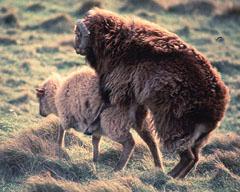
Well, it's damn hard to get to, but once you get there you'll never want to leave: Lasqueti Island. I've visited several times over the past five or six years, as Rachel's mom has a place on the Island, and I absolutely love it: no car ferry (only pedestrians), off grid, no paved roads, gorgeous coastlines and all the oysters you can eat. And feral sheep!

Rachel and I will be reading at the Lasqueti Arts Centre Thursday, March 22 at 7:30 pm. Come on down!

Tuesday, March 13, 2007

Assies toy sur le bort d'une ondante riviere

I've been working my way through John Hollander's anthology Sonnets: From Dante to the Present. It has its flaws (especially Hollander's invention of titles for untitled sonnets, whereby John Donne's "Batter my heart..." becomes "The Soul to Her Rescuer," which is crapulently unequal to such a brilliant piece of poetry), but is on the whole a lovely little book. (I love the Everyman anthologies, so perfectly pocket-sized and pretty, with their built-in cloth bookmarks.) And it has some surprises in it. Such as a sonnet by Jean-Baptiste Chassignet (1571-1635), as translated by Frank Warnke:


Water Never the Same [another of Hollander's lame inventions, methinks]

Beside a flowing river sit and gaze,
And see how it perpetually runs
In wave on wave, in many thousand turns,
As through the fields it takes its fluid ways.

Thou'lt never see again the wave which first
Flow'd by thee; water never is the same;
It passes day by day, although the name
Of water and of river doth persist.

So changes man, and will not be tomorrow
That which he is today, he cannot borrow
That strength which time doth alter and consume:
Until our death one name we do retain;
Although today no parcel doth remain
Of what I was, the name I still assume.

***

This isn't too bad--I like the slant-rhymes in ll. 2/3 and 5/8--and is very faithful (line-to-line sense and rhyme-scheme-wise) to the original, as it turns out, but what's with all the thees, thous and doths? This might be understandable if it was an old translation, but it's from Warnke's 1975 book European Metaphysical Poetry. 1975! Warnke's probably trying to convey the informality of the address in Chassignet's original, but whereas the "tu/vous" distinction still means something in French, the "thou/you" distinction suffered extinction some time ago, with "you" now serving as a general purpose form of 2nd person address. "Thees" and "thous" just sound poncy nowadays. The diction in Chassignet's original is actually less archaic than Warnke's translation, for all its old-fashioned orthography:

Assies toy sur le bort d'une ondante riviere

Assies toy sur le bort d'une ondante riviere
Tu la verras fluer d'un perpetuel cours,
Et flots sur flots roulant en mille et mille tours
Descharger par les prèz son humide carriere.

Mais tu ne verras rien de ceste onde premiere
Qui n'aguiere couloit, l'eau change tous les jours,
Tous les jours elle passe, et la nommons tousjours
Mesme fleuve, et mesme eau, d'une mesme maniere.

Ainsi l'homme varie, et ne sera demain
Telle comme aujourd'huy du pauvre cors humain
La force que le temps abbrevie, et consomme :

Le nom sans varier nous suit jusqu'au trespas,
Et combien qu'au jourd'huy celuy ne sois-je pas
Qui vivois hier passé, tousjours mesme on me nomme.


***

I've had a bash at it, trying to make it sound like a more contemporary poem in English:

THE SAME MAN NEVER STEPS INTO A RIVER TWICE


Find yourself a flat stone by the riverbank,
Sit down and watch the river purl and froth
And flow; note where it pools and how its flanks
Straighten and bend into bows. It is both

Protean and permanent. You’ll never
See the same wave twice; the molecules
Of H2O won’t sit still and make fools
Of sages who would fix them. But clever

Man has done it, naming this forever
Fitful stream of fluxity, nailing its
Matrix, water, and its channel, river,
As if they were as still as stone. A man sits

By a river. He is no more the same
Man he was, yet he bears a constant name.


Visits from the South

Wow, interesting people drop in when you write a post about a prominent Arab poet. Not just that poet's translator, who left a wonderfully gracious comment (thank you, Dr. Joudah), but also some more surreptitious visitors from the States. From the District of Columbia, in fact, Veterans Affairs in the US Federal Government, who came to my humble blog--twice!--after googling the title of Dr. Joudah's translation of Mahmoud Darwish's work. It's good to see US g-men taking an active interest in poetry, especially poetry written by an Arab associated with the PLO and the Communist Party. Three cheers for the cosmopolitan literacy of US bureaucrats!

Sunday, March 11, 2007

Submit to Me

In response to this post, Michael Reynolds asked "why give up on sending out magazine submissions?"

To clarify, I do still send work to magazines, but almost exclusively at the invitation of an editor.

I have a few reasons for this. In no particular order:

1) The success rate for unsolicited submissions is low and I don't much like engaging in futile activities. I'd sooner save the postage costs for things I know I'm going to enjoy.

2) The readership of literary journals is small, even with subscriber lists inflated by contest entries, so the occasional success is small potatoes, even by poetry standards.

3) I find the editorial standards of the journals lacking, not only in taste, but in focus. As I said in another post, I rarely find enough good poetry in a journal to want to buy it. If I'm not interested in the magazines, it seems pretty vain, if not hypocritical, to ask to have my work appear in them. If one day you curse a magazine for publishing such boring poems and the next they publish yours, what does it say about your poems? About you? If, on the other hand, an editor goes out of their way to ask you for your work, you at least have some indication that there is an editorial direction, rather than a committee trying to agree on what work offends the sensibilities of the fewest members.

Another related issue is the representation of regional writers in regional journals. In Arc there are a lot of Ottawa poets; in Fiddlehead, a lot of UNB writers, etc. (There are other connections less obvious to the casual reader. For instance, I published a 7-sonnet corona in Fiddlehead a while ago. Their poetry editor asked me for the poem after I read it at UNB; and I was crashing at her house at the time. There's a similar backstory to the publication of three of my poems in Existere. A number of my other publications have been solicited by editors I already knew personally and/or professionally. This is not in and of itself a bad thing, but when the editor has somewhat less-than-critical judgment, it can be.) The disproportionate representation of local writers is clear evidence that there is a strong non-literary bias at work, which mitigates against one's chances of getting published in that magazine if one doesn't have a local connection. Again, a strong editorial bias is not a bad thing, in and of itself--as in the case of an editor asking for a specific poem because s/he liked that poem or for a submission because s/he likes other poems of mine. This is a sign of having editorial discretion and ambition--of having taste, which isn't much evident, one way or t'other in a lot of magazines. But when that bias leans towards non-literary factors, it certainly is a problem. Maybe the outside work being rejected is of equal or lesser merit than the local work being accepted, but a reader should be forgiven for doubting it.

4) Journals tend to publish one or two poems by a poet, which I find generally unsatisfying, unless the poems are exceptionally good, which is rare as lightning. When editors have asked me for work, they have generally published four or more pieces at once.

5) When I used to submit work to magazines, I would often be unhappy with the work by the time it finally appeared in print. When I first started writing, I submitted often to different magazines. As my publication history shows, there's a gap between 2000 and 2004 during which I published almost nothing in any form. This was the point at which I became disenchanted, for the above reasons, with doing things comme if faut and decided not to play the submit-to-me game anymore. To do my writing, read as much as I could and learn the craft without any worry about the scene. I was thinking about having my book self-published, in fact, when interest in my work from a couple of people led to me signing a contract with Insomniac.

6) I think chapbook publication, whether it be by a micro-press or by the writer him- or herself, in combination with public readings, is a far better avenue than journal submissions if you want to test out your work and try to find an audience for it. I continue to publish work in chapbooks and broadsides. And lately, as anyone following my blog can see, I've been publishing new work online. I like to have control over it. If I'm unhappy with some aspect of a poem I've published here, I can edit it or simply delete the post. And I can publish them in audio formats too, which is an important thing for me, but which is impossible in print journals--as well as with most book publishers, though this seems to be changing. It's all in my control. If an editor asks me for any of the poems that I put up here, I'm glad to see them in print, but I don't see the need or benefit of mailing them out with SASEs and holding my breath hoping for a validation that I deem dubious at best. I mean, I haven't even heard of most journal editors, so why should their decision to choose my poem mean much to me?

All this is not to say that no one should send work to magazines. I just think it's a highly overrated means of publishing poetry.

Saturday, March 10, 2007

Mahmoud Darwish

The other day, I picked up The Butterfly's Burden, a translation of three recent books by Palestinian poet Mahmoud Darwish. Having absolutely no knowledge of Arabic, I can't say how fair the translation, by Fady Joudah, is to the original, but it is, unfortunately, not always great English verse. Joudah, a medical doctor, writes poetry and although there is some discussion of prosody in his introduction, it's probably best to read these as cribs, somewhat prosaic English approximations of the original, probably more faithful to the literal sense of the poems than to their music--or perhaps trying to create in English some semblance of Arabic music that just isn't coming through. Nevertheless, some of the metaphorical imagination of Darwish does make it successfully into English. I was particularly taken by the imagery in "Sonnet II," even while I was frustrated by its syntactic longueurs:


Perhaps when you turn your shadow to the river you ask
of the river only obscurity. Over there a little autumn
sprinkles the stag with water from a fugitive cloud
there, on what you have left for us of departure's crumbs

Your mystery is the Milky Way. The dust of nameless planets,
and your mystery is night in pearls that illuminate only water.
Whereas speech can illuminate with one phrase
"I love you," the emigrant's night between two odes and two palm tree rows

I am who saw his tomorrow when he saw you. I am who saw
gospels the last idolater wrote on Gilead's slopes
before the ancient lands or after. And I am the returning cloud
to a fig tree that bears my name, as a sword bears the murdered's face

Perhaps, when you turn your shadow to me, you give incident
to metaphor as a meaning to what is about to happen ...


***

The Butterfly's Burden is an en-face translation. Obviously, I can't make syllabic sense of the Arabic script on the left-hand page, but it certainly looks more compact than this metrically-challenged sprawl. It's too bad that Dr. Joudah didn't have another poet working with him on the translation, someone like Ted Hughes, who did amazing work with poets such as Miroslav Holub, who wrote in languages Hughes didn't understand, someone who could have helped turn a labour of love into a better labour of art.

I was sufficiently taken by Joudah's translation to attempt a revisioning of the poem myself. This is tricky business, obviously. As I discovered comparing David Harsent's versions of Goran Simic's Sarajevo poems in Sprinting from the Graveyard to their recent "retranslation" in From Sarajevo, with Sorrow, it can be very easy to betray, with the best of intentions, the intent of the original work. It turns out that, almost without exception, Amela Simic's "cribs" make for better poems than Harsent's versions, which often seemed to editorialize the poem's content through omission of controversial images and statements.

***

(Disclaimer: What follows is a free adaptation of Joudah's translation of Darwish's Arabic poem. I make no claim of authority on its behalf.)

SONNET

after Darwish

Turn your shadow to the river and demand
It stay dark. A little autumn sprays the stag
With rain from a stray cloud, sprays a little
Rain on abandoned litter on the strand.
The Milky Way, god semen or spittle,
Is a mystery and yours is a bag
Of strewn pearls flashing in the night’s black hand,
A phrase that lights the migrant river’s night
Between one psalm and another. I saw
All of my tomorrows in the white
Of your eye; I heard the last false idol’s
Gospels. And I came, a rain-pregnant thaw
Bearing motherland’s pain like a title
Deed, jabbed like a rusted spade in your jaw.


Friday, March 9, 2007

George McWhirter

A few weeks ago, I attended a gathering at the home of George McWhirter and his wife Angela. I stayed a little while after everyone else had hustled home, to chat with George and Angela, who are warm, funny, delightful people. So I was glad to learn the other day that George had been named as the inaugural poet laureate for the city of Vancouver, a decision which yesterday was made official. I have ambivalent feelings about the idea of poets laureate in general, largely because poor choices are so often made (see Canada's first two incumbents, George Bowering and Pauline Michel), but I'm pleased my new city has at least made a sensible selection.

Before I left the McWhirters', George and I traded books and I've been reading his Book of Contradictions with pleasure since. There's a shambling irreverence in the humour and often exuberant imagery of his poems that I find quite endearing. Here is his poem Overboard.

Another article on George's laureateship.

How Am I Doing for Time?

I go to a lot of poetry readings and have been doing so for years. Sometimes I wonder why. A persistent masochistic streak, I suppose. Most poets are just so bloody oblivious to the basics of public speaking, never mind dramatic performance, that watching them read is more irritating than enjoyable. Some poets appear so uncomfortable you get the impression they'd rather be doing anything else. Granted, the skills required for solitary writing and those needed to engage a live audience are vastly different, but if you're going to attempt the latter and don't feel at ease with the task, it is possible to improve through practice and training. Take voice training, an acting class, public speaking lessons, something! At least rehearse what you're going to read a few times before you take to the podium. Your audience came to hear your poems; you owe it to both auditors and the poems you've worked so hard on to give them the best possible performance.

Which doesn't mean being dramatic and hyper-intense. A lot of poets who don't suffer from a surfeit of meekness kill the mood with Anne Sextonesque melodrama, all snarly and growly. It means reading with expression and emotion, not in that ponderous, pretentious tone known as "poet voice," which. is. supposed. to. emphasise. the. words. but, wholly unnatural in its androidal absence of klangenfarben, actually has the opposite effect, drawing more attention to the reader of those words, not less. It means knowing the text of the poems well enough so that, even if you don't have them perfectly committed to memory, you at least don't stumble over your poem as though it were some strange speech written by someone else in a language you only recently started learning. And it means not running on at the mouth with endless, rambling introductions to the poems; this is a surefire way to get your audience daydreaming before they even hear the poems themselves.

Although I respect a poet like Don Coles who is famous for not reading his poems in public (much to the consternation of his publisher when Coles' Forests of the Medieval World won the Governor General's Award in 1993), this seems to me an extreme position. If you're publishing a trade book, isn't it a bit disingenuous to despise public performance?

There are a number of poets I love listening to. John MacKenzie is one; before John published his first book, I checked out a reading he gave in Charlottetown, PEI, and was mighty impressed. Pleasant surprises like that one--along with the above-mentioned predilection for self-torture--are what keep me coming back to readings again and again. George Elliott Clarke is another top-notch reader. His high-energy style verges on the bombastic, but that's a fitting match for the sound-rich lushness of his writing and a quite authentic manifestation of his outgoing personality. You'll never catch George asking timidly how he's doing for time (a major pet peeve of mine: if you have a hunch you've been up there too long, best to assume that you have and wrap things up; at worst, you'll leave the audience wanting more, which is never a bad thing) and he has vast swathes of his own work committed to memory. The American poet, essayist and funeral home director Thomas Lynch is another excellent reader. I first encountered his work at a reading he gave at the Blue Metropolis Festival in Montreal a few years ago. His dayjob has no doubt helped make him comfortable in public settings. And I posted a little while ago about the outstanding reading by Anne Caston I attended recently. In both cases, strong readings were what persuaded me to take their books home with me.

Public reading has always been an important and enjoyable facet of my own writerly vocation (This is probably another thing that keeps me coming to other poets' readings; not terribly reasonable to expect people to attend your events if you take a pass on theirs.), at least as important as print publication. Probably more so. I actually seek out reading venues, whereas I gave up sending out unsolicited submissions to magazines and publishers some time ago. Last year, I embarked on a 22-reading cross-Canada tour which I'd organised myself. Dani Couture interviewed me about it a while back for Northern Poetry Review. One of the biggest obstacles facing living poets in this country is geography; a lot of poets, some of them quite good, get read by very few people outside their home region. The only really effective way to change that is to make personal contact with an audience. And try to make that contact as memorable as possible.

Thursday, March 8, 2007

Hannus!

Just found out that my lovely and talented wife, Rachel Lebowitz, has been nominated for a BC Book Prize for her first book, Hannus, a multi-genre biographical work on the life and times of Ida Hannus, Rachel's great- grandmother, who emigrated from Finland as a teenager and was part of the utopian socialist community of Sointula on BC's Malcolm Island. The prize Hannus is up for is the Roderick Haig-Brown Regional Prize for a book that contributes to the enjoyment and understanding of British Columbia. Obviously, this is terrific news for Rachel and her book, which everyone should buy and read!

Also up for a prize, in the poetry category, is Steven Price for his widely-lauded Anatomy of Keys, a poetic biography of Harry Houdini, which is one of my favourite books of poetry published in recent years.

Wednesday, March 7, 2007

Interview Uploaded

For anyone cursing about having missed my interview on CiTR yesterday, you can listen to it here.

As a postscript, Linda tells me that while our insecticidal measures seemed to work at first, the bugs have made a comeback. Think I'll stick to working on the train--where we almost never get bedbugs.

CBC, that Bastion of Democratic Radio

A few days ago, I posted about some, shall we say, questionable editorial practices on the part of CBC Radio producers and hosts. Well, now they've gone from stodgily prudish to outright censorious. Booker Prize-winning novelist Yann Martel was told he could not read excerpts from Hitler's Mein Kampf in an interview--about the freedom to read banned books! During Freedom to Read Week! Because they were afraid of offending listeners! CBC Saskatchewan is in some pretty fine company here, joining the ranks of that great ally to free thought, Heather Reisman, who banned the book from her stores in 2001. Difference is, Reisman's a private business owner, whereas you and I, brothers and sisters, own the CBC. If, like me, you think this is an egregious violation of the CBC's mandate as a public broadcaster, then please share your opinion with them.

I have:

I just learned of CBC Radio Saskatchewan's censorious refusal to allow Yann Martel to read from Mein Kampf on air. Given that he was being interviewed about his reading from the book as part of Freedom to Read Week, I find this not merely ironic, but grossly irresponsible. As a citizen in a putatively free democracy, I expect my public broadcasting system to show greater reverence for the freedom of individual expression. The only thing for it is to have Martel back on the air to talk about the restrictions placed upon him by CBC--and to read from the book. The producer responsible for this travesty should also have to publicly apologise on air and if he declines to do so, he should be subject to disciplinary action.

Sincerely,

Zachariah Wells
Writer
Vancouver, BC

Tuesday, March 6, 2007

Infested

Today, an interview of me by Linda Besner will be broadcast on UBC's CiTR radio. Linda has one of the strangest and funnest gimmicks for her show. She has the poet she's interviewing read one of their poems whilst host and poet are engaged in an activity related to the poem's subject matter. In my case, the poem is "The Exterminator's Song to the Silverfish." Yes, that's right, we'll be killin' some bugs. Dead. If you like the poem and would like your very own copy, it's published in my chapbook, Ludicrous Parole, which is available from Montreal's Mercutio Press. There are three other poems from the chappie here.

If you're in the Vancouver area and wish to tune in, it's 101.9 on the FM dial and the segment runs from 2:00-2:30 pm, Pacific Time. If you're not in Vancouver, you can tune in via the CiTR site's live streaming.

For those unable to tune in, you can check out this recording.

Monday, March 5, 2007

Hey, Teacher, leave those kids alone!

A thoughtful opinion piece at The Danforth Review by Dean Serravalle, a teacher and writer, on how teachers are accomplices in turning kids off reading.

I've done quite a few classroom reading/discussion sessions in high school, college and undergrad university classes and I have to say I've found the students on the whole very receptive to poetry--at least to my version of it--and often they ask penetratingly intelligent questions. One smart lad in Geoff Cook's college course pointed out something, in the form of a question, I hadn't quite realized about my writing: "Why are there so many references to alcohol in your poems?" After recovering from the initial shock of having a foible exposed in public--it took me longer than it might have normally, as Geoff and I had been out late the night before--I gave him a personalized version of the write-what-you-know axiom.

My experiences may well just be proof of what Saravelle is arguing. As a younger guy who writes a lot in an idiom familiar to younger people, my stuff would probably appeal more to such a crowd than poetry, no matter how good, with more formal or abstract diction and themes.

Chicago

John MacKenzie has a post on a nifty-sounding Homer reading aid over at Salt and Ice, in which he also sings the praises of the city of Chicago.

No one, of course, has done this more memorably than Carl Sandburg, whose "Chicago" has a place of honour in my personal poetry anthology. AUDIO

Another recording
by Roy Trumbull. It looks like Mr. Trumbull has quite the rich archive of recordings on the go.

Cornucopious

An opinon piece I wrote on the state of poetry publishing in Canada is now online at Arts News Canada.

For related reading, see my post of February 7.

Heron, False Creek

A new poem. And a Vancouver poem, at that. I must be settling in. AUDIO.


HERON, FALSE CREEK


There, Heron, you stand
in my shadow, stick pegs
and twigged feet steeped
in the freezing Creek’s

shallows, scissor-beaked
slink neck stapled
to a feathered bundle.
There, Heron, you stand,

avatar of angler’s
waiting, waiting, calm
as monks praying, steeped
in the shitty Creek’s

tide-drained stink—
then tensile—blink—
like a Singer’s
stainless needle,

that scissor beak
stabs the reeking
Creek, springs back
with silver, flipping,

flashing in the seawall
lamp standard’s
glare. With a slurp
and a shake, like

a puffy glutton
at Monk’s Oyster Bar
(stilted in False Creek’s
salted shallows)

sucking a shucked mollusk
from its crusted
shell, you swallow,
Heron, stand there

in my shadow, stare
up at the seawall,
skronk, and awkwardly
flop up into the air.


Sunday, March 4, 2007

The Ballad of Eskimo Nell

As part of "Freedom to Read Week," last Thursday I attended a reading downtown. At a bar afterwards, a few of us were talking about book banning, censorship, etc.

I've never experienced anything so dramatic as outright censorship myself, but I have felt pressure at times to read material that is "suitable." I've had reading hosts advise me, after I'd read poems with foul language in them, that next time I might pick different poems, as some members of the series' regular audience might not have approved of my diction. And when my chapbook Fool's Errand was published in the spring of 2004 by Saturday Morning Chapbooks in PEI, I went to the Island for the launch. Prior to the launch, I was interviewed for the CBC's local afternoon show. The host asked me, during the course of the interview, to read a poem from the chapbook. I chose the title poem, mainly because it was one of the best pieces in the book--not thinking that its subject matter (dogs fucking) might be contraversial. At the end of the interview, the host asked me if I wouldn't mind reading just one more poem, at which point I started to suspect something. And sure enough, in the edited interview broadcast that afternoon, "Fool's Errand," a poem with no four letter words but with some hot dog-on-dog action, was cut.

The CBC is generally pretty bad about this kind of thing. When I was in Saskatoon on my book tour last winter, I met Holly Luhning, who was competing in the CBC Poetry Faceoff in Regina, and was told by the local producer that she couldn't use the word "vulva" in her poem. She agonised over this some, but decided to leave it in and read it anyway. When the poem was broadcast, the offending word was bleeped. Now, I might concede that CBC had a valid objection if she had used the term cunt, or even pussy [that should spike traffic on the site!], but Ch-ee-rist, vulva is an anatomical term! And the CBC has plenty of daytime programming with more contraversial content than this. Why can you have something in a drama, but not in a poem? I guess poetry's supposed to be genteel...

The previous year, 2005, I'd been invited to take part in the Faceoff. I accepted, even though I had serious concerns about the rules against bad language and sexually explicit content. Every year, the Faceoff has a theme, to which the competing poets must write an original poem. The theme in 2005 was "play." So I decided to play a game with my poem. Here it is:

GAME


It happens maybe once in a lifetime,

Happens with the caustic burn of quicklime,
A
nd when it happens, you won’t have a clue—
V
ery little at least—why it was you
E
xempted from verse’s struggle in vain,

Not someone else. Your taut portraits of pain?
O
r was it all the long hours of study,

Fiddling with syllables in the ruddy
U
nbaffled glow of a beeswax candle,
C
ursing your abject failure to handle
K
indled verbs, adjectives, improper nouns
I
n your too-proper paws—no ups, all downs,
N
o mercy, just grief dogging your black pen’s
G
ouge across page after page, whats and whens

Inked in, crossed out, those crucial hows and whys
D
im in your mind at best. If you were wise,
E
very false step would bring you closer to
A
rriving at the conclusion that you

Weren’t fit to play this kind of idle game,
H
eaping lines in a twisted, crooked, lame
A
crostic code—but wisdom doesn’t come
T
o lovers, lunatics, poets. The sum

Total of your fraught work is a big fat
O
, a totem pole of bent beasts. So what?

Write it anyway. If all the world’s a page,
R
ip it out. Start clean. Ex nihilo, rage
I
nside that tight white frame, engage the pain
T
hat cripples most to strut you over plains
E
rupt in flame, corrupt with shame, on stilts

Five feet above the bluish air that wilts
O
zone-smothered poets, pets and flowers.
R
ip it out again. One line might take hours

To justify its life from all the dreck
H
arboured by your draft like sharks in a wrecked
E
mpty vessel that just circle, circle,

Circle, waiting inside their nautical
B
reakfast nook for unsuspecting divers
C
ombing the site for florins and stivers.

Pace most poets, poetry’s a game
O
f chance that can’t be learned or rendered tame—
E
xcept if you play it by a set of rules.
T
hen you may pen lines to please the smug fools
R
unning the magazines, teaching in schools,
Y
earning to make friends, longing to belong,

Fit in, be cool—but such lines won’t last long,
A
float like flies on a pond full of fish.
C
up a hand to ear for the whoosh, splash, splish
E
fflorescing the stagnant pondwater’s
O
range face, rejoice in the small slaughters
F
illing the gullets of salmon and trout.
F
eed on it. And don’t for a second doubt

Brutality’s claim to beauty and truth—
U
nless the law of a tooth for a tooth
T
urns your sensitive lily-white stomach,

In which case, get thee to yon wee hummock
T
o record sweet lines on bee and butterfly’s

Mating dance, or any other white lies
U
psetting to no one. You’ll make more friends
S
pouting liqueur than logging the quick ends
T
hat animals suffer— But that is not

How this game is played. In case you forgot
A
llegiance is due to none but the Muse;
V
erily, verily, life’s but a ruse
E
nding in death: the loyal worker bee’s

Stinger embedded in flesh, apiary’s
O
verflowing culmination in swarm,
M
onarchs frozen in millions seeking warm
E
mpires south of the snow— Verse is a game
T
hat we play for keeps, no sanction for shame,
H
urt feelings or sleep. Like Dante, descend
I
nto hell. You may bring with you one friend,
N
o more, so choose well from the queued-up dead
G
roaning past on a belt of smelted lead

Trays. Keep your head. Let your eyes needle out
O
ver featureless waste. Accommodate doubt.

Doubt is the only sure sign you’re alive,
O
ne length ahead of the bees in the hive

Worried about their health plans and pensions,
I
ncome tax, mortgage debt, hypertension.
T
his dead pledge to the devil ends when paid,
H
eaves its last sigh when the last card’s been played,

Played, played in multiple takes, bread and wine
L
aid out for your mourners to snack on—thine
A
llowance of grace, Muse, nickel and dime;
Y
et it made me a rich man once in this lifetime.

***

When I submitted my draft to the CBC Halifax producer, I hid the acrostic by not capping and bolding it and by deleting all the stanza breaks. At the live event, however, I passed out photocopies of the poem, with the acrostic in plain sight, to members of the audience. The producer approached me and said, "Can you do that?" I told her I wasn't sure, but I could check the contract--which I knew full well said nothing about providing the text of the poem to the audience. No one listening to the poem on the radio would have the slightest clue about my little game, but it felt good to pull a fast one on the Corp.--and get paid to do it! The producer also didn't appear to get the poem's not-so-subtextual mockery of the idea of writing a poem for pay.

I'd like to leave you with a poem whose offensiveness is much less subtle: one of my favourite pieces of anonymous doggerel, "The Ballad of Eskimo Nell," which really takes the piss out of Robert Service, in a loving sort of way. Well, maybe loving ain't the mot juste... Here's the text. And here's the audio.

Friday, March 2, 2007

Don Paterson

I was reminded today of this wonderful lecture given by Scottish poet Don Paterson. I can't say that I'm completely with him on all counts, but there's lots of chewy stuff here. Enjoy.

Red Ledger

My review of Mary Dalton's new book, Red Ledger, is now online at Quill & Quire.

I've been a big fan of Dalton's work since reading her taut little sequence of dialect monologues, Merrybegot. She has developed one of the most individual voices in contemporary poetry, steeped in tradition and true to the local. It's not something I expected, after reading her second book, Allowing the Light, which is a decent collection, well-crafted, etc., but nothing to knock your socks off. There really was a quantum leap between it and Merrybegot, although there were kernels of it showing in the earlier work; a couple of the poems in Merrybegot, which came out about ten years after its predecessor, were originally published in Allowing the Light, and a few of the poems in Red Ledger are also drawn from her two early books.

We've got an excellent review of Red Ledger coming up in the next issue of Canadian Notes & Queries, written by Mark Callanan.

Some other Dalton stuff on the web:

A couple of poems from Merrybegot

A review of Merrybegot

Another

Books in Canada
review of Merrybegot at amazon.ca (for some reason, it's not available on the BiC website)

A trialogue review of Merrybegot I did with John MacKenzie and Steven Laird at Bookninja

A review of the audio recording of Merrybegot

A review of Red Ledger

An interview with Dalton at CBC

Thursday, March 1, 2007

Overhead Crane

In the summer of 2001, I spent my weeks off work in Vancouver. In the giftshop of a BC Ferries boat, I came across a book called Going for Coffee, an anthology of poems about work edited by Tom Wayman. I was interested in work poetry because I was writing quite a bit about my own job at the time, loading airplanes in Nunavut--poems that I would eventually publish in my book Unsettled--so I bought the book. Most of the poems in Going for Coffee were pretty forgettable, anecdotal, haphazardly crafted things. But one poet, Peter Trower, stood out. He had a few poems in the anthology, and all of them were miles above the rest; gritty poems about logging and industrial work, but with an individual music of the sort a poet doesn't just find accidentally. On the trip back across the Strait, I bought Trower's Chainsaws in the Cathedral, his collected logging poems, and I've been reading him ever since. My poem "Forklift Operator Wanted; Recreational Facilities Provided," I dedicated to Peter because, although I wrote it before encountering Pete's work, my poem was a kind of cousin to his "Overhead Crane," which was one of the poems in Going for Coffee that I first fell in love with.

After trading a few letters in 2005-06 and a few phone conversations after I moved to Vancouver in November, Pete and I finally met in person towards the tail end of last year, in North Vancouver, where he lives part time. Not surprisingly, even though Pete's in his mid-seventies and I'm just a pup, we got on like a house on fire. After that meeting, I wrote this poem:

AFTER OUR MEETING: EPISTLE TO TROWER

Dear Peter,

The day was auspiciously fine;
Riding my Shadow in unusual sunshine
On this wet west coast in December
Simply sublime. Can’t remember
Ever having her out this late, much less
Enjoying the weather. After I crossed
The bridge over Second Narrows, I passed
Thru Dollarton, Lowry’s haunt, headed west
Along the tracks down Low Level, past
Those godawful elevators, looming
Colossal over the grain cars. Christ,
The pharaohs built nothing to beat em! The grass
Was green between the rails and the scent
Of rye and wheat’s boozy ferment
Entered my nostrils to lodge in my noggin.
(You and me both have distilled the cost
Of following that whiff too far, tobogganed
A little amok.) I thought of us and of
The women persistent in their perverse love—
Your Yvonne, so lately departed,
And my Rachel, better judgment
Bested only by the muscle of their hearts—
While I watched the densely packed zooming
Of pigeons above. It’s a sentimental
Lie that doves mate for life, never unfaithful—
But that does fuckall to disprove
The existence of endless love.
I was glad to find you as well
As can be expected, despite all you’ve lost.
Pete, let’s do this again before long.

**

Here are a few other things on Pete from the web:

AUDIO of me reading "Overhead Crane"

A short essay I wrote about Pete's "Industrial Poem" for Arc

My review of Haunted Hills & Hanging Valleys, Pete's Selected Poems

Carmine Starnino's review of HH&HV (well worth the read)

A review of There Are Many Ways

Another one