Friday, February 20, 2009

Thursday, February 19, 2009
Wednesday, February 18, 2009
More Awards Shenanigans
So the Commonwealth Prize shortlists have been announced. One of the Canadian authors shortlisted is married to one of the judges. Can't wait to hear about how this isn't a conflict of interest.
UPDATE: Thanks to Steven Beattie for posting this link. Apparently, Dr. Banting had nothing to do with Mr. Stenson's book being on the shortlist and will have nothing to do with whether it wins or loses. Prize administrator Jennifer Sobol has been quoted as saying you can "stick a needle in [her] eye" if this ain't so.
Tuesday, February 17, 2009
Praise Song for the Not-Lame
A while back, I suggested that Martin Espada would have made a much better inaugural poet than Elizabeth Alexander. Re-reading his occasional elegy/praise song "Alabanza" today, I was reminded of just how much can be done in this mode by a poet not hamstrung by a) a lack of native ability and b) a desire to cater to the common denominators of a crowd and the goodwill of the powers that be. To those who defend Alexander's poem as a piece of democratic plain speech, as opposed to high-falutin ivory tower poetic esoterica, I would say that "Alabanza" is plain speech par excellence, in that fine American tradition inaugurated by Whitman: plain speech with rhetorical verve, with rhythmic propulsion, with emotional valence. Espada's poem is written to people, whereas Alexander's was written about a subject. "Alabanza" soars, whereas "Praise Song for the Day" shuffles, stutters and sinks. Apparently, she's said she'll never read it again. Smart move.
Monday, February 16, 2009
Happy 100th, Abraham

This year, were he still alive, AM Klein, one of Canada's most significant and verbally inventive poets would have turned one hundred. Two days ago, I believe. I love a lot of Klein poems, but none so much as "Heirloom."
Hear me read it:
VILLANELLE OF THE SERIAL SPERM DONOR
I have sired more young than Genghis Khan.
I went into a room with a cup and magazine.
I haven’t ever met a single one.
I did it for a dollar, I thought it might be fun.
I didn’t think, at first, that it would mean
I’d sire more young than Genghis Khan.
Spread out my offspring on a lush suburban lawn,
You wouldn’t see one little blade of green—
But I’ve never met a single one.
At any given moment, twenty ovens, twenty buns
Rising like the beanstalk from the bean.
I have sired more young than Genghis Khan.
No one tells me where it is that all my seed has gone.
It’s just as well, they’re only genes.
I don’t ever want to meet a single one.
I like to go to bars at night, I like to cruise for cun.
I really dig the swingin’ singles scene.
I have sired more young than Genghis Khan.
I don’t think I’ve ever met a single one.
James Langer's Bushcraft

I recently had the opportunity to review the galleys of Gun Dogs, the forthcoming debut collection by James Langer. I can't say much about it here, as my review's not published yet and nor is the book, but I think you should check it out when it is. Here's his poem "Bushcraft."
Jack Pine: The Opera
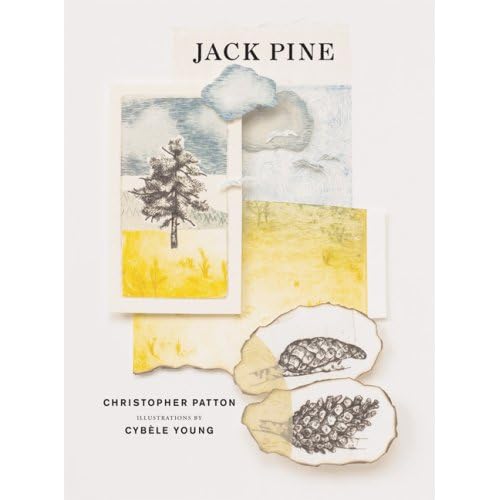
Rachel, Kaleb and I headed over to North Vancouver yesterday to attend the grand opening of Jack Pine, an opera for children based on the book by Christopher Patton. The libretto and music were written by Veda Hille, who is a musical favourite in this household.
The opera was alright, but we came away with the impression that Chris's text wasn't ideally suited to adaptation. The best element of the show was the core part, which used Chris's poem. The story built around the poem felt like ... a story built around a poem. There was also a lot of "educational" content about trees that was more didactic than lyrical. The thing as a whole was a bit long for young kids. (Tho it should be said that K almost made it thru the whole thing without fussing.)
The book, which we bought in the lobby, is a thing of beauty, both the text and Cybèle Young's artwork. I highly recommend it.
Sunday, February 15, 2009
A wee lesson in demographics
In the Globe and Mail, Cormorant Books publisher Marc Coté laments the fact that only 20% of books purchased by Canadians are Canadian-authored. He blames this on "colonialism" on the part of the UK and "protectionism" on the part of the US. He says nothing about Franco-Canadians and France, which seems a significant oversight. One can understand how these factors would affect sales of Canadian books outside of Canada, but it's unclear how they are supposed, in Coté's mind, to be hampering domestic sales.
This needs, rather badly, to be put into statistical perspective. The population of Canada is about 33 million. The combined populations of the UK, US, Ireland, Australia, New Zealand and France: 465 million. So our population is less than 7% of the grand total of almost 500 million people. Hm, 7% is a lot less than 20%. Interesting. Could it be that, pace persistent nationalist rhetoric, Canadian books actually over-achieve in their domestic sales? Seems like it. Especially when you consider just how many of our people come from other countries and have mother tongues other than English or French. Especially when you consider that the language spoken and read by the majority of Canadians is the world-dominant language.
Coté is right to complain about subsidies not keeping up with inflation. That should be fixed, if it's so. But I wish he wouldn't bemoan the cosmopolitan tastes of Canadian readers. It's a bit ... provincial. I'm gonna go back to reading my Faulkner novel now.
Saturday, February 14, 2009
Love, Lobster Lust and Bad Luck
Here's the audio from my reading last night, graciously hosted by Jane Mellor and The Writers' Studio.
From the People Who Brought You Such Things as the Weekend
It sounds as though, after 35 years of operation, the Writers' Union of Canada is finally going to start performing some of the functions of a union. It's kind of ridiculous how many leagues, associations, federations and unions for writers there are out there. I've never joined one, in part because I share Groucho Marx's view of clubs that would have me as a member, but also because I've never seen any benefit in membership. At least none commensurate with the annual fees. But I would like to retire from the labour force in another five years or so (right about the time that I'd have to start working year round on the railroad); if TWUC has bona fide medical and pension plans by then, I might actually consider signing up. All the other parliaments of fowls would do well to fold themselves into TWUC to eliminate redundancy and maximise benefits to members. But I imagine there's way too much territorial pissing for that to ever happen. Another problem is that TWUC, for reasons known only to its legislators, does not admit writers who haven't published a book. So if you're a full-time freelancer, as of right now, you're shit out of luck. But if you're a crappy poet whose book was published by your best friend, come on in. If they're serious about getting medical and pension plans started, they really need to drop the arbitrary exclusion criteria.
Something in this story I found bemusing is the statement that some 3000 "writers" declared no earnings from their writing. How can someone report this without commentary? I wonder how many "gardeners" found themselves in a similar predicament. At some point, you have to stop pretending that your past-time is your occupation. It's figures like that that make me very damn skeptical of statistical surveys on such things. 3000 zeros skew the numbers pretty damn badly.
Friday, February 13, 2009
What makes for a good reading?
A thoughtful blog post at the Guardian on the good, the bad and the ugly in poetry reading, with lots of links to various poets reading their work. One of the links is to this recording of Wallace Stevens reading "The Idea of Order at Key West." Very different from my oral interpretation of the piece:
Thursday, February 12, 2009
HARD TIMES
You can tell it’s hard times for the arts
By how many buskers are out hustling
Quarters on street corners. You can tell
By their bewildered looks, the exceeding
Refinement of their style and their swell
Manners that they are unaccustomed
To such crude environs and to the rude
Rebuffs of passers by with no intention
Of being detained. Pity the poor buggers,
Forced by the twin threats of starvation
And creditors, from their studios, stages
And pits out into the dinful, bustling
Market. They are such sensitive creatures—
Can’t you see how your lack of appreciation
For the nuances of their interpretations
Plunges them into sullen depression?
Can’t you see how brutal it is for them
To be grateful for the handful of change
You toss in their box as you stroll by?
Readings
I'm off to see the forever youthful duo of Patricia and Terence Young read tonight at the Robson Square bookstore. I'll see about bootlegging it, just for you.
And if you're in Vancouver, don't forget about my reading tomorrow night.
Wednesday, February 11, 2009
Palmu on the Couriers
Brian Palmu has reviewed Peter Richardson's recent book Sympathy for the Couriers in a very unorthodox manner: he goes thru the book poem by poem, giving us a paragraph or two on each. Lately, I'm so much more interested in talking about individual poems than collections; I guess this is one way to do both. Peter's poems deserve the attention and don't get it nearly enough, in my biased opinion. He got his start as a published poet late in the game, but he's miles ahead of most of his contemporaries, never mind mine. And related to the Birney quote I posted in my last entry, he spent a career as an Air Canada ramp hand. Maybe working for a living is good for poetry...
Get a Job
My advice to young Canadian writers is ... to take a temporary part-time job. It could even be in a university, especially in a Creative Writing course, so long as it is temporary or part-time. But better perhaps to fish salmon in the season and work on novels out of it it, as one ex-student of mine is doing; or run a rooming house and write plays for the CBC, which is how a young woman I know is managing both to live and to write what she wants; or take a nine-to-five banking job with no homework, as Raymond Souster has done.
--Earle Birney, "The Writer and His Education"
Subscribe to:
Posts (Atom)

