Friday, February 29, 2008

Moves

Sometimes I wish my career really did limit my moves. It's been six months since we moved to New Westminster, and it's proven to be something of a failed experiment. Nice pad, draughts and leaks aside, but not a terrific location. So we've signed over our lease to someone else and are moving in to a basement suite in East Vancouver on Saturday. We won't have our phone/'net hookup till Tuesday apparently, so things will likely be quiet here till then.

For those few of you who occasionally send me things that can't be transmitted by wire and signal, our new address will be

2760 William St.
Vancouver, BC
V5K 2Y8

If you've sent me something to the old address, don't fret, we've got CanPost forwarding the mail.

Thursday, February 28, 2008

Is sense/nonsense an untenable dichotomy produced by oppressive binary logic?

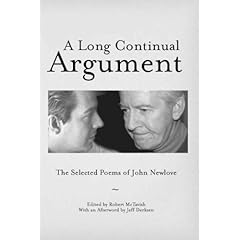
Thanks to Jenn for the link to this refreshing article about academics' misuse of language to make simple--simplistic even--ideas seem complicated. Or complexified, if you will. This is something that Rob Taylor complained about--justifiably--in his review of John Newlove's new Selected, specifically in the afterword by Jeff Derksen. I just finished reviewing the book too, and can't for the life of me understand why the publisher would think that piece of jargon-larded bafflegab was an appropriate closing note to the selected works of a poet who disliked theory and was dedicated to an ethos of clarity in his own writing. It seems almost disrespectful.

Here's a poser: If Whitman was alive and writing today, would he say that he contains "pluralities" or "multiplicities"?

Monday, February 25, 2008

A WINTER

It was a winter of atmospheric depressions
It was a winter of anhedonic ennui
It was a winter of dumb indecision
It was a winter of her, a winter of me


It was a winter of silt in the Fraser
It was a winter of tugboats and freight trains
It was a winter of rust on the razor
It was a winter of nightmares and rain


It was a winter of dull unemployment
It was a winter of landlords and in-laws
It was a winter of ill-planned deployments
It was a winter of hammers and saws


It was a winter of wrongheaded answers
It was a winter in which nothing clicked
It was the winter the cat died of cancer
It was the winter you quickened and kicked


In Praise of Melancholy

As a follow-up to my last post, I thought I'd share this article by Eric Wilson with you. I heard him on CBC the other day talking about his new book Against Happiness: In Praise of Melancholy, which sounds quite compelling. I've long thought that the increased medicalisation of unhappiness can't be a good thing.

(Thanks to Jane for the link.)

Sunday, February 24, 2008

No Pleasure

No one in Canadian poetry does existential misery like John Newlove. Maybe John Thompson, but generally with lest directness than Newlove. At his best, Patrick Lane comes close; Fraser Sutherland's a contender, but Newlove is King of Pain. Outside Canada, he's maybe topped only by Weldon Kees and Philip Larkin. It's not my favourite poetic mood, but when it's rendered well, it can make for poetry every bit as memorable as more positively charged verses.

I'm reviewing the new Selected Newlove, A Long Continual Argument, and was particularly struck by the poem, "No Pleasure," taken from Newlove's GG-winning Lies. I've had some anhedonic episodes myself this winter, and it struck a chord. There are some excellent insights into this sort of thing in another book I read recently, Oliver Sacks's Musicophilia, about how hearing a funeral march played buoyed his spirits during a period of protracted anhedonia, when nothing else did. Misery does indeed love company.

Hear me read "No Pleasure."

Pith and Vigor

I'm sure this is making the rounds, so apologies if you've seen this catalogue of zingers already, but some of them are so delicious, I simply haaaaad to post them.


The exchange between Churchill & Lady Astor: She said,
"If you were my husband I'd give you poison," and he
said, "If you were my wife, I'd drink it."

A member of Parliament to Disraeli: "Sir, you will
either die on the gallows or of some unspeakable
disease." "That depends, Sir," said Disraeli, "whether
I embrace your policies or your mistress."

"He had delusions of adequacy." - Walter Kerr

"He has all the virtues I dislike and none of the
vices I admire." - Winston Churchill

"A modest little person, with much to be modest
about." - Winston Churchill

"I have never killed a man, but I have read many
obituaries with great pleasure." Clarence Darrow

"He has never been known to use a word that might send
a reader to the dictionary." - William Faulkner (about
Ernest Hemingway).

"Poor Faulkner. Does he really think big emotions come
from big words?" - Ernest Hemingway (about William
Faulkner)

"Thank you for sending me a copy of your book; I'll
waste no time reading it." - Moses Hadas

"He can compress the most words into the smallest idea
of any man I know." - Abraham Lincoln

"I didn't attend the funeral, but I sent a nice letter
saying I approved of it." - Mark Twain

"He has no enemies, but is intensely disliked by his
friends." - Oscar Wilde

"I am enclosing two tickets to the first night of my
new play; bring a friend.... if you have one." -
George Bernard Shaw to Winston Churchill

"Cannot possibly attend first night, will attend
second... if there is one." - Winston Churchill, in
response.

"I feel so miserable without you; it's almost like
having you here." - Stephen Bishop

"He is a self-made man and worships his creator." -
John Bright

"I've just learned about his illness. Let's hope it's
nothing trivial." - Irvin S. Cobb

"He is not only dull himself, he is the cause of
dullness in others." - Samuel Johnson

"He is simply a shiver looking for a spine to run up."
- Paul Keating

"There's nothing wrong with you that reincarnation
won't cure." Jack E. Leonard "He has the attention
span of a lightning bolt." - Robert Redford

"They never open their mouths without subtracting from
the sum of human knowledge." - Thomas Brackett Reed

"In order to avoid being called a flirt, she always
yielded easily." - Charles, Count Talleyrand

"He loves nature in spite of what it did to him." -
Forrest Tucker

"Why do you sit there look ing like an envelope
without any address on it?" - Mark Twain

"His mother should have thrown him away and kept the
stork." - Mae West

"Some cause happiness wherever they go; others,
whenever they go." - Oscar Wilde

"He uses statistics as a drunken man uses
lamp-posts... for support rather than illumination." -
Andrew Lang
(1844-1912)

"He has Van Gogh's ear for music." - Billy Wilder

"I've had a perfectly wonderful evening. But this
wasn't it." - Groucho Marx

Saturday, February 23, 2008

"You are beginning to sound paranoid, with the dark forces of mediocrity arrayed in a plot against quality."

I posted links to a couple of hilarious interviews a while back, one with Steven Pinker and one with Daniel Dennett. The incredibly obtuse--and yes, paranoid--interviewer's still at it. Here's his latest car-wreck, with Phillip Lopate. Enjoy.

Thursday, February 21, 2008

Dodds Takes the Cake

Just found out my buddy Jeramy Dodds (pictured left), who not that long ago won the Bronwen Wallace Award, has just taken top prize in the CBC Literary Awards. [ed. note: Nice haul, Jer!] If this keeps up, Jeramy will soon be the wealthiest archaeologist/poet in Canada. (Tho most of the wealth is generated by the illegal sale of unearthed artifacts, not from literary prizes.)

For those of you wondering where your pre-ordered copies of my chipbook After the Blizzard are, Jeramy knows. He has your money. Guess he's been too busy writing his own poems to publish mine. Sniff. [ed. note: sorry, Jer, my intern wrote that. So hard to get good help.-Z]

You can hear Jeramy reading some of his work here.

Rumour has it Jeramy's first book will be coming out with Coach House in the near future. Look out for it

ON JARGON


The auscultation
Of obfuscation?
Ostentation.

The deification
Of reification?
Defecation.


Sunday, February 17, 2008

Purdy to be Perch for Birdies

So there's to be a big-ass statue of Al Purdy installed in Queen's Park in May. I'm not surprised to hear that this is happening and I don't think it's inappropriate. I'm a fan of Purdy's best poems and he was an early influence on my own writing. But this is a bit irksome on a couple of counts.

Altho Scott Griffin and Toronto City Council and no doubt many others have "no doubt" that Purdy "was the guy, if you were going to do it at all,"--really, what else would he say after dropping a couple hundred grand?--it seems to me that if we're going to have a statue for just one Canadian poet, it should be Irving Layton (whom, it should be noted, Purdy once hailed as being "as close to genius as any poet alive"). For that matter, I don't find Purdy's best poems as compelling as several other Canadians' top-drawer verses: Elizabeth Bishop, Earle Birney, Milton Acorn, P.K. Page (altho I don't think we should raise statues to poets while they're still among the living), Charles Bruce, Kenneth Leslie, Richard Outram. Several other poets are/were as good as or better than Purdy.

But of course, the business of statues has much to do with the business of status. In his life and in his work, Purdy did more to enhance and cement his status as a writer--and as a Canadian Poet--than most other poets (Layton probably did more, but his public persona was much less cuddly than Al's). Purdy did far more than just write poems: he travelled widely, he mentored, he anthologised, he edited, he welcomed admirers and disciples into his home, he banged the drum of cultural nationalism, he ambitiously cast himself as a national poet in a country of regions. In short, he made a myth of himself, and his particular myth (the wearing-his-learning-lightly autodidactic, aw-shucks, late-blooming, plain-speaking man of the people and man of the place) is one that most Canadians cotton to far more readily than, say, Layton's vituperative, bawdy, brash, self-aggrandizing and world-historical cosmopolitan projections. Since his death, the Purdy hagiographers have been busy accentuating the positive and glossing over the negative aspects of Purdy's life (including portraying bad habits as lovable eccentricities) and the limitations of his poetry. He's become something of a symbol, and I think this would genuinely bug the guy were he still alive. I'm sure he'd be the first to take a leak on that big bronze statue.

PS: In response to Brian's comments to this post about the nationality of Elizabeth Bishop: It is true that Bishop is most commonly labeled a U.S.American poet. Canadian grandparents, however, also means a Canadian mother. And her father, tho a successful entrepreneur in New England, was originally from Prince Edward Island. So, two Canadian parents, a Canadian childhood and several returns during adulthood to visit Canadian family. Biographically, a very Canadian person. The Elizabeth Bishop Society of Nova Scotia recently acquired Bishop's grandparents' house in Great Village NS, and have made it into a writers' retreat.

Literarily, the subject matter of many of her most famous poems ("Filling Station"; "Sestina"; "At the Fishhouses"; "The Moose"; "Sandpiper"; "Cape Breton"; "First Death in Nova Scotia"; "Manners") as well as that of her most acclaimed short story, "In the Village," is explicitly Nova Scotian. And while Nova Scotia may have more in common with Massachusetts than it does with Saskatchewan, last I checked, it's in Canada. Speaking of which, a handful of Bishop's poems appear in the 2002 anthology Coastlines: The Poetry of Atlantic Canada, and very recently "The Moose" was featured in Arc's all-Canadian "How Poems Work" column.

It says on that page that Bishop's publisher granted permission to reprint "The Moose." I haven't got my copy of Coastlines handy (it's in Nova Scotia, dagnabbit!) but I assume that Goose Lane's reprinting was also authorized. Perversely, I was recently
denied permission to reprint a Bishop poem in my fortchoming anthology of Canadian sonnets--because Bishop "is considered an American poet and including her work in an all-Canadian anthology may cause some confusion." Well, I doubt that. The "confusion,"--let's call it ambiguity, since that's a more neutral way of labeling it--caused by the facts of Bishop's life, already exists; putting her in the book would only reflect it. Denying permission, on the other hand, is causing me some confusion. The reasons for denying Bishop's Canadianness are arbitrary, the reasons for acknowledging it anything but. Once her work passes into the public domain, I hope it becomes routine to put her in our anthologies. She deserves it far more than many--most--of the usual suspects.

Friday, February 15, 2008

Bowhead Hyper-text

To give an idea of what I was talking about in my previous post about noting obscurities in a poem, I've taken the poem in question and hyperlinked various things, more or less obscure (who decides?)--excluding instances of ambiguity caused by polysemy (rot, corrupting) or homophonic puns and leaving alone the question of possible buried intertextual allusions to passages in Barry Lopez's Arctic Dreams and Herman Melville's Moby Dick--to Wikipedia (or elsewhere, when not covered by Wikipedia). So, is "maqtaq" really the most obscure thing in this poem? To whom? Why note it and not everything else?

Bowhead


I can hardly stand the rot
our cargo wafts: the redolent fat
of a Greenland Right, this year's legal
cull of ancient rites
cross-stacked
aft of me in plastic-strapped
waxed boxes, despite which snappy
package, stench of maqtaq
drenches this Hawker, as it did holds
of Victorian whalers, the same reek
at sixteen thousand feet as a hundred
stripped crangs corrupting
on Pond's Bay floes -- London's
streetlamps aglow and Oxford dons
dry ‘neath baleen-ribbed brollies --
the same as it must have been -- and still is
in this land that hoards scars
and preserves what it kills --
cached under stacked stones
a thousand-odd years ago.

Unsettled Review

John Mutford has posted a review of Unsettled on his blog, along with a sharply chosen soundtrack to accompany the book. Nice to still get the odd word about the book more than three years after its publication. John, being an Iqaluit resident and an employee of the very airline I worked for, has some insights not many other readers would have. And he got the "hydroponic cucumbers" reference in "Nomads"!

I won't say much about the review, since silence on these matters is almost always the best policy, but I will answer his complaint that there's no glossary or notes page. I thought about doing this, but decided against it. An early self-published chapbook version of the book, In Exchange for a Piece of Rock, has a pretty extensive notes section. But since doing that chappie in 2001, I became annoyed with notes in poetry collections. I figured that this is strange territory (hence my epigraph from the Book of Exodus, "I have been an alien in a strange land") and the odd arcane detail or piece of foreign language should be left unexplained. When you wander in a foreign city, you don't have a historian hovering over your shoulder explaining each new thing you see--unless you take one of those annoying guided tours. When you make a new friend, that person doesn't reveal everything about herself right away--nor even over the course of a life-long friendship--but through long-term acquaintance you come to know her well.

Most of the things left unexplained in the book are available to the assiduous reader. John cites the specific case of "maqtaq," which appears in my poem, "Bowhead." As he says, I think context gives a pretty good idea of what this mysterious and malodorous substance might be. Consider also this news item, available to anyone with access to Google (I think that might actually be the whale that inspired the poem; the timing's right). Granted, it's a Nunavut newspaper, but still, there's no explanation of what precisely "maqtaq" is. Trawl a little farther on Google, and you'll find this item, which offers a definition.

Part of a poem's reader's work is ferreting out unfamiliar references. I have no great fondness for poems so clogged with such allusions that the plain everyday sense of the thing is impenetrable on a first or second read. But I also don't like it when the odd indecipherable moment is explained by the author, either in the poem itself or, slightly less bothersome, in notes at the back of the book. (And the problem is, once you start annotating, where do you stop? How much obscurity is prerequiste of a note? In a book like Unsettled, rife not only with localisms but also with literary allusions, a notes section could easily run to ten or twelve pages.) Once the poet has finished writing the poem, the balance of the work has to be done by the poem's readers--should they feel so compelled. Some of those readers might be scholars, who will gloss the allusions a casual reader might not get; but if that casual reader is reading the scholarship, it's a sign already that they've found the poem worth diving into. A poem is like anything else in the world we come upon; it stands or falls as it is and if it needs guywires or buttresses to keep it upright, it's probably better just to let it collapse. For me, providing a note is holding the hand of the reader too much, and potentially depriving the reader of the pleasure of seeking out those answers on their own. I know I personally love the "eureka!" moment when a long-mysterious allusion in a poem I love comes clear to me years after first encountering.

Anyway, that's my justification for leaving things unexplained, and I'm stickin' to it!

Thursday, February 14, 2008

Happy VD

In celebration of their 7th birthday and Valentine's Day, the good folks at Forget Magazine have uploaded a whole whack of new love-themed content, including a sappy little poem I wrote called "Love Song: Thou Alone." The poem was written as a response to Alan Dugan's poem "Love Song: I and Thou"--kind of a nymph's reply to the shepherd thing, only with more hardware.

Wednesday, February 13, 2008


After some postal misadventures, my copy of CNQ 72 finally arrived the other day and I've been gobbling up the content that I hadn't already read. Highlights, aside from the many fine reviews in my section, include Roy MacSkimming's interview with Margaret Atwood and Graeme Gibson; Irving Layton in an interview with David O'Rourke; Phil Marchand's devil's advocacy against Alice Munro; essays by Clark Blaise on the short story and Charles Foran on linguistic verve; a very good piece by Andrew Steeves of Gaspereau Press on the design of poetry book covers and the tyranny of the colour photo in same; new poems by CNQ contributing editor Amanda Jernigan.

Something I'm very heartened to see is a lively letters page. In a response to a letter by Gordon Phinn, Alex Good mentions that the previous incarnation of CNQ got one letter in 7 years. Well, this issue received three! One of them is a very short note from Dennis Lee that has me so chuffed I can't resist reproducing here:

I've just read issue 71, and found it so bracing I wanted to let you know. Bravissimo! Piece after piece has a wonderful mix of intelligence, maniacal caring, and (dare I say it?) generosity of spirit. Almost gives you hope for critical thought in this country.
It's quite appropriate that Lee's letter should appear in CNQ 72, since he features prominently in the issue. He comes up frequently in the Atwood/Gibson interview, in which Gibson paints a vivid picture of Lee's own "maniacal caring" when it came to editing Gibson's novel Five Legs. Also, he is the subject of what I think is the finest contribution to the reviews section, James Pollock's "Cursing with a Broken Art." James' review is not, on the whole, full of praise, but it certainly has that mix of fine qualities Lee found in 71 (which included James' excellent review of the anthology Open Field, to which the book's editor sort-of-responds in a spluttering display of inarticulation here). Anyway, I hope it doesn't dampen Lee's enthusiasm for the magazine. I doubt it will, battle-scarred vet that he is. He was a key player in the ferment of Canadian literature and publishing in the 60s and 70s, and while I don't agree with all of his causes or positions, I certainly do respect his enormous energy and contributions.

In related news, CNQ got a mention in the Globe and Mail from James Adams a little while back, as one of "the best magazine reads in the racks." I haven't read the piece myself, so if anyone with a subscription wouldn't mind pirating the text and emailing it to me, I'd be most grateful. Dear G&M, when will you get with it and drop the damn paywall?

Vancouver Verse Map

George McWhirter, Vancouver's Poet Laureate, is looking for site-specific Vancouver poems for an anthology/atlas to be published by Anvil Press. I've got a couple I think I'll submit; how about you?

Vancouver’s first Poet Laureate, George McWhirter, invites poetry submissions for an anthology on the features that give Vancouver its identity, such as its streets and place names.

This call for submissions is open to anyone who wishes to help fill the gap in Vancouver’s verse geography. There is no fee to enter. Authors whose work is chosen for the anthology will be paid $25 per page or poem.

Poems should ideally be a two-sonnet length, and cross streets or place names for the poems should be provided. Submissions must be typewritten and sent with a self-addressed, stamped envelope to the publisher at the following address by July 31, 2008...

VPSN

A Verse Map of Vancouver
c/o Anvil Press Publishers
278 East First Avenue
Vancouver, BC V5T 1A6

The Poet Laureate will also make the selections for and edit the anthology, which will be published in spring 2009.

During his honourary two-year term from 2007-2009, the Vancouver Poet Laureate acts as a champion for poetry, language and the arts and will create a unique artistic legacy through public readings and civic interactions.

For more information:

City of Vancouver, Corporate Communications, 604.871.6336

Jean Kavanagh, Vancouver Public Library, Marketing and Communications, 604.331.3895


Countermand my trousers

Stumbled upon this gem today. Can't recall if Steven Pinker mentioned this in The Stuff of Thought, but he should have!

Monday, February 11, 2008

Poetry and Song

Back in September, Paul Vermeersch and I had an extended--and probably stupid--argument about the relationship between poetry and song. Paul said they were different things; I said they were too closely related to be completely distinct. Paul committed several logical errors. I won.

In case there's any doubt of it, this story in the NY Times (thanks to Zeke for the link) about French singer Carla Bruni's musical treatments of Dickinson, Auden, Yeats, Christina Rossetti and Dorothy Parker poems gives weight to my argument that poetry and song are too intertwined to separate them neatly. And I'm backed up by no less a Paul than Mr. Muldoon. So there, Vermeersch.

Sounds like a seriously sexy album. Anyone familiar with her singing?

Friday, February 8, 2008

Belated

I somehow failed to notice that this blog turned 1 year old a couple of days ago. Which is probably significant of nothing.

Thursday, February 7, 2008

Steven Pinker on Morality

Thanks to Brian for pointing out this piece.

Forget "can." Routinely does, more like it.

This sort of stuff is always compelling, but so many people seem to not want to think of it, to trust their shudder reflexes as reliable guides. (Much of Margaret Somerville's thinking is little better than rationalised shuddering.) In a democratic society, each citizen, for better or for worse, is in the position of being a moral arbiter. The more critical the individual's apprehension of moral issues, the better that person is bound to be as a judge and as an actor. Of course, some people will always be moral morons, but the less we encourage moral stupidity, the less dangerous those morons will be.

I'm reading William T. Vollmann's Rising Up and Rising Down: Some Thoughts on Violence, Freedom and Urgent Means (the condensed version, not the 7 volume behemoth), in which Vollmann examines the questions of moral calculi and justifications, valid and otherwise, for violent acts. Pinker's next book is to be on violence, too, I hear. Looking forward to that.

Other related reading I would recommend highly are Nietzsche's books On the Genealogy of Morals and Beyond Good & Evil (Walter Kaufmann, trans.). Nietzsche was a ground-breaking iconoclast in the philosophy of morality and his insights have lost none of their sharpness with time.

Podcasts

David Helwig's added a bunch of podcasts to the PEI Poet Laureate's site, including one of me reading my poems "Skunk" and "Field of Floes."