Saturday, January 31, 2009

Friday, January 30, 2009
Thursday, January 29, 2009
On Masculinist Aggression
Dale (last name?) addresses a pet peeve of mine: the anti-intellectual shut-up tactic of saying that a contrary point of view expressed by a man is an act of aggression, bullying, attempted intimidation, what have you. In my experience, this is usually a very thinly veiled way of sneaking out the back door once someone has called bullshit on a patently bullshitty statement. But that's just my aggressive masculinist perspective, eh.
(from Squandermania)
Wednesday, January 28, 2009
Knee-Slappers
An hilarious list of mock-academic essay titles. The next step is to find out just how many of them have been written...
Riddle Fence Wants You!
The good folks at Riddle Fence, who are publishing a couple of my poems in the near future, are looking for submissions for the less-near future. Why not send 'em somepin?
CALL FOR SUBMISSIONS
Call for Submissions to Riddle Fence Issue #4
For Immediate Release
January 19, 2009
Kill Date: March 2, 2009
Riddle Fence, a Newfoundland-based journal of arts & culture, is currently accepting submissions for its fourth issue.
We are currently considering previously unpublished submissions of poetry, fiction, creative non-fiction, and reviews. Please send no more than 3-4 poems or 1 piece of prose, maximum 5000 words in length. Payment is $30 per printed page (prose and poetry) for first Canadian serial rights, plus a copy of the issue in which your work appears.
What are we looking for? What is anyone looking for: brilliance, innovation, that certain je ne sais quoi de sage-like insight that will blow away the doldrums and give our lives greater meaning.
The deadline for submissions is March 2, 2009.
Please note, due to the extraordinary volume of email submissions received for previous issues, we will no longer be considering electronic submissions. We apologize for any inconvenience this may cause. Submissions may be made by regular post (please include a self-addressed stamped envelope or sufficient IRC postage in the case of submissions from outside Canada):
Riddle Fence
PO Box 7092
St. John's, NL
A1E 3Y3
For more information, contact us by email at riddlefence@gmail.com, or visit our website: www.riddlefence.com
Canadian Poetry--the Molson Ad Campaign Version
Molly Peacock has been blogging about the new Best Canadian Poetry anthology, over at the Best American Poetry blog. If I haven't said it here before, I think it's a remarkably strong anthology. And I'm glad to see the involvement in it of someone like Peacock, who straddles the US/Canadian border. I'm a bit dismayed to see her making broadstroke generalisations about Canadian verse over at the blog, however. I always find those kind of synthesizing analyses, whatever kernel of truth they might contain, obscure far more than they reveal and do nothing so much as perpetuate a prejudice. Should I be Canadian now and say, "But that's just my opinion"?
Tuesday, January 27, 2009
Probably the closest I'll ever get to being in Poetry
Jason Guriel, whipsmart poet and critic who's been blogging for Harriet, has written up Evie Christie's Desk Space blog, and used my messy office as an illustration. If I'd known company was coming, I'd've cleaned the place up. Or not. I'm moving in a couple of months anyway.
Souvankham Thammavongsa

I've been reading Souvankham Thammavongsa's books in preparation for a review. I'm digging her work far more than I expected to. She is the quintessential minimalist and my own predilections tend to be for the maximalist. But what she's doing is so damn precise and ruthless. I wasn't surprised to find, in various interviews, that she's very smart and has uncommonly keen insights into the hows and whys of her work.
Thought I'd share some of the fruits of my internet trawling. Below are choice quotations with links to the interviews whence they came. Below those, various links to her work in various formats on the web. Enjoy.
Thought I'd share some of the fruits of my internet trawling. Below are choice quotations with links to the interviews whence they came. Below those, various links to her work in various formats on the web. Enjoy.
I don’t really like poets. They are awfully boring and not honest about anything at all. [From an interview in The New Quarterly, which is, alas, not available online]
*
*
*
I know that there are expectations for me to write a poor immigrant story or about my pussy or about making jam sandwiches by the window while staring out at the snow.
*
Short talk about self-publication given by ST
Review of a performance piece by ST and others, with a link to a recording
Video adaptation of an ST poem, by Kat Burns
Monday, January 26, 2009
A Minor Disappointment
Last year, Rachel and I both applied for a residency at Berton House in Dawson City, Yukon. Today, we learned that, along with 74 other applicants, we didn't make the cut. I was glad to see, however, that Pasha Malla and Jeramy Dodds, talented and charming men both, did. Congrats, fellas.
WRITERS’ TRUST TO SEND AUTHORS NORTH:
Upcoming Writers-in-Residence of Berton House Announced
January 26, 2009 – The Writers’ Trust of Canada has announced the four writers that will be writers-in-residence at the Berton House Writers’ Retreat during the 2009-10 year. Each writer will travel to Dawson City, Yukon, to live in the childhood home of Pierre Berton for a three-month period.
The writers selected are:
Pasha Malla (July to September 2009)
Born in St. John's, Newfoundland, raised in London, Ontario, and now living in New York City, Malla’s first collection of short stories, The Withdrawl Method, was published in 2008 and appeared on the Scotiabank Giller Prize longlist. He is currently working on his first novel.
Linda Goyette (October to December 2009)
An award-winning newspaper writer and editor, Goyette is a past recipient of the Atkinson Fellowship in Public Policy and Grant MacEwan Author’s Award. She lives in Edmonton and is working on a non-fiction book exploring the evolving nature of childhood in northwestern Canada.
Mylène Gilbert-Dumas (January to March 2010)
A French Canadian writer, Gilbert-Dumas has published award winning historical and science fiction novels for young adult readers. She recently published Lili Klondike, the first of a three-part series on the Klondike Gold Rush. She lives in Sherbrooke, Quebec.
Jeramy Dodds (April to June 2010)
The winner of the 2006 Bronwen Wallace Memorial Award, Dodds lives in Fredericton, New Brunswick. His first collection of poems, Crabwise to the Hounds, was published last year. He is working on a translation of Poetic Edda from Norse / Icelandic to English.
Eighty applications were received from writers wishing to be part of the program. Applications were assessed by a three-member committee comprised of Dawson City-based young adult novelist Joanne Bell, and two past writers-in-residence, playwright C.E. Gatchalian and novelist Russell Smith.
To date forty-five writers have spent time at Berton House since its inception in 1996. Writers each receive a monthly honorarium, perform public readings, and interact with community residents. To be eligible for the program, applicants must be professional Canadian writers who have published at least one book and are established in any creative literary discipline (fiction, non-fiction, poetry, play/screenwriting, journalism).
The program is funded through an annual fundraising gala organized by the Berton House Writers’ Retreat Society and chaired by Elsa Franklin. Additional support for the retreat is provided by the Canada Council for the Arts, Dawson City Community Library, and Klondike Visitors Association. The Writers’ Trust is also grateful for support received from Aeroplan, the City of Dawson, Random House of Canada, and the Whitehorse Public Library.
For more information visit bertonhouse.ca
Ottawater
Three poems of mine have just been published in the online PDF magazine, Ottawater, dedicated to the writing of Ottawa residents, past and present. The first two poems (starting on page 118 of the mag) are Haligonian satires based loosely on Juvenal's Roman satires. If memory serves, I wrote them in the summer of 2005. I thought I might do a longer sequence of them, but my attention span got the better of me after three. The expansive, discursive voice in them is far from something that comes naturally to me when writing verse, so I consider them experiments. Thanks to Robert for publishing them.
Sunday, January 25, 2009

There's a lively discussion about visual poetry--more specifically about criticism of visual poetry or lack thereof, perceived or actual--going on over at the Harriet blog.
For my part, I've long wondered what substantive difference, if any, exists between a certain strain of typographical poetry and typographical logos created by graphic designers. What, for instance makes the image above not a poem and the image below a poem?

They're obviously different, but it's a difference of degree more than a difference of kind, isn't it? Aren't they both, fundamentally, typographical collage?
And how about this famous image:

Why is this a painting and not a visual poem?
I have a friend who is a visual artist. A couple of her works in progress are 1) a "shapetionary," or a dictionary that organizes objects not according to alphabetical order but according to their shape (e.g. a pineapple would be found in the same neighbourhood as a hand grenade) and 2) cutting all the periods out of certain books and arranging them as a collage. I've talked to her about both these projects and never once has she used the term visual poetry. Is she practicing it without being aware of it? Or is visual poetry--to be precise, most forms of it--more a visual than a lexical art form? Is the terminology useful?
The strawman figure defensively cut by champions of vispo is that of the reactionary philistine who stamps his feet and insists vehemently that what they do isn't Poetry. I know there are some out there who fit that profile, but then there are others who don't feel the need to defend Poetry from the barbarians--it needs no defending--but who wonder if the use of the terms "poetry" and "poem" don't frame this work in an unproductively imprecise manner. I'd say I'm one of those people. Personally, I can't say I'd classify much of the vispo I've seen as poetry, but as visual art. Which is a different thing altogether from saying it isn't Poetry.
The distinction isn't original, but it's one dealt with particularly eloquently by Robert Bringhurst--who happens to be a world-renowned typographer as well as a poet and probably has invested more time thinking about the "solid form of language" than the vast majority of soi-disant visual poets--in his recent collections of talks and essays. I think the following passage is analogically a propos:
If the vast majority of visual poems fail to be Poetry, then, truly, they are no different from the vast majority of lineated text-based poems. If they fail to be Art, then they are no different from the vast majority of paintings, drawings and collages. Which is one reason why I don't call myself a poet and my uncle, who is a painter of no small accomplishment, doesn't call himself an artist.
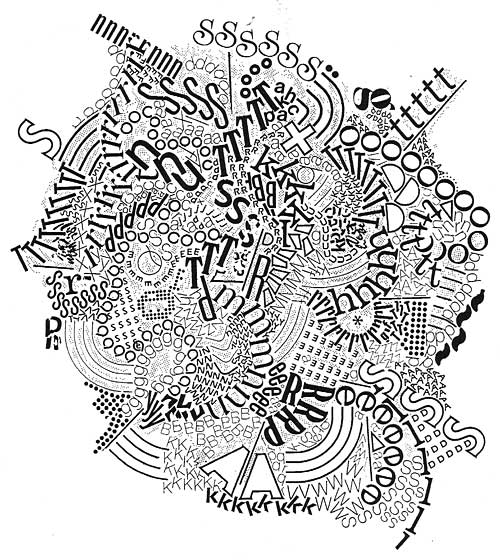
They're obviously different, but it's a difference of degree more than a difference of kind, isn't it? Aren't they both, fundamentally, typographical collage?
And how about this famous image:

Why is this a painting and not a visual poem?
I have a friend who is a visual artist. A couple of her works in progress are 1) a "shapetionary," or a dictionary that organizes objects not according to alphabetical order but according to their shape (e.g. a pineapple would be found in the same neighbourhood as a hand grenade) and 2) cutting all the periods out of certain books and arranging them as a collage. I've talked to her about both these projects and never once has she used the term visual poetry. Is she practicing it without being aware of it? Or is visual poetry--to be precise, most forms of it--more a visual than a lexical art form? Is the terminology useful?
The strawman figure defensively cut by champions of vispo is that of the reactionary philistine who stamps his feet and insists vehemently that what they do isn't Poetry. I know there are some out there who fit that profile, but then there are others who don't feel the need to defend Poetry from the barbarians--it needs no defending--but who wonder if the use of the terms "poetry" and "poem" don't frame this work in an unproductively imprecise manner. I'd say I'm one of those people. Personally, I can't say I'd classify much of the vispo I've seen as poetry, but as visual art. Which is a different thing altogether from saying it isn't Poetry.
The distinction isn't original, but it's one dealt with particularly eloquently by Robert Bringhurst--who happens to be a world-renowned typographer as well as a poet and probably has invested more time thinking about the "solid form of language" than the vast majority of soi-disant visual poets--in his recent collections of talks and essays. I think the following passage is analogically a propos:
Still, I want to know whether "philosophical poetry" is a useful term ... I suppose the attempt at a "philosophical poem" could fail tactically in either one of two ways, or in both. It could fail to yield poetry, in which case what remained might or might not still be philosophy. Or it could fail to be "philosophical," in which case what remained might or might not prove to be poetry of some other kind.
If the vast majority of visual poems fail to be Poetry, then, truly, they are no different from the vast majority of lineated text-based poems. If they fail to be Art, then they are no different from the vast majority of paintings, drawings and collages. Which is one reason why I don't call myself a poet and my uncle, who is a painter of no small accomplishment, doesn't call himself an artist.
Review online
My review of Tim Bowling's latest collection, The Book Collector, is now up on the Quill & Quire site.
Saturday, January 24, 2009
Elizabeth Bachinsky

An interview with my pal Elizabeth "Biz" (probably only to me) Bachinsky, in which she answers a couple of awkward questions with grace. Really looking forward to the new collection (and digging the cover design).
Friday, January 23, 2009
Wednesday, January 21, 2009
Dionne Brand reads at UBC
I'm off to Greene College in a couple of hours to see Dionne Brand read. I've never heard her read before, so I'm looking forward to it. I'll see if I can bootleg a tape for y'all.
UPDATE: I've decided to bail. The temperature's near freezing and the roads are damp, so it's not safe for motorcycling and it's too damn far for transit. For my liking.
Friends or Foes
"Contemporary writers may generally be divided into two classes - one's friends or one's foes. Of the first we are compelled to think too well, and of the last we are disposed to think too ill, to receive much genuine pleasure from the perusal, or to judge fairly, of the merits of either." -- William Hazlitt
(Swiped from Squandermania)
Tuesday, January 20, 2009
Surprise, Surprise
Another article in the new Quill & Quire tells us that the mandatory Cancon for English classes in BC is making little to no difference in what gets taught. I wonder who said that would happen...
Here's a deal: if you're a BC English teacher and you want to teach a book I've written or edited, I'll donate half the copies you need and sell the other half at cost (40% discount from cover price). Not all at once now.
Oy, what a crappy poem
And an even worse reading. What's with the e-qual em-pha-sis on ev-er-y syl-la-ble? We speak a stress-timed language, fer christ's sake! Contrasted to the speeches and speaking of Obama and the preacher who delivered the benediction, Elizabeth Alexander looked worse yet. Would have been interesting to see what, say, Martin Espada would have done with such a commission...
UPDATE: A pretty incisive critique of just what's substandard about Alexander's poem.
UPDATE 2: Adam Kirsch on why Alexander's poem sucks. Which seems another good argument for someone like Espada, someone who is not an establishment figure, someone who actually has a lot of firsthand experience of disenfranchisement, who has lived in Hell's Kitchen instead of just knowing about/having ancestors who picked cotton. But let's face it, Obama's way more about assimilation than protest. As such, Alexander was, as Kirsch puts it, a "too perfect" choice.
Subscribe to:
Posts (Atom)

