Sunday, November 24, 2019

Olga Tokarczuk

One must keep one's eyes and ears open, one must know how to match up the facts, see similarity where others see total difference, remember that certain events occur at various levels or, to put it another way, many incidents are aspects of the same, single occurrence. And that the world is a great big net, it is a whole, where no single thing exists separately; every scrap of the world, every last tiny piece, is bound up with the rest by a complex Cosmos of correspondences, hard for the ordinary mind to penetrate. That is how it works. Like a Japanese car.
 --Drive Your Plow over the Bones of the Dead, translation Antonia Lloyd-Jones

Monday, November 18, 2019

INVADER


Got nothing against
them, they have a right

to exist, I just can't
tolerate their ilk

taking shelter here. This
is where I live—my

home. They're dirty;
I have a duty

to defend my family.
After I flooded

a burrow in the yard
one turned up

in the house. We packed
all the dry food

in the kitchen
into plastic

containers, woke
to find them

shredded and scattered.
That's when we knew

no harmless wee
mouse was this. Our kid

just a baby,
we were scared

it might visit
his crib at night.

It bored a hole
through the baseboard

back of the fridge,
clearly had a track

between there and
the plumbing under

the sink. We bought
warfarin, snap traps,

we went on alert.
Third night of its

occupation, I heard
a rustle from

the cupboards. I slipped
on my loafers

and crept into
the kitchen. I swung

the door below the sink
open and the crinkling

stopped. Behind cartons
of bin bags, rags

and cleaning supplies,
I sensed it was there.

I kicked a box,
out it flew, I brought

my foot down
and trapped it,

belly-up, struggling.
Her teats were bulging—

she must have been
gravid. My heart

beat hard, I pressed
down harder, her body

as large as my size-ten
loafer, repulsive

skinny tail a good
six inches extra.

I bore down on her
until damn sure

she was no longer
breathing, then dumped

the dam and her unborn
pups in the green bin.


Tuesday, November 12, 2019

A PRIMER ON ACTING


        i.m. Ker Wells


Just say what you see, damn it, say it plain,
clear, show nothing, and forget expressing
emotion, you'll have better luck squeezing

a turd through your tympanum. Blue heron
on her stilts in the silt-scummed shallows
of the Clyde never concentrates, but she's

paying attention and knows what to do
at her wait's end, executed with bloodless
aplomb. You on your stilts in the tall grass

of the riverbank, cousin, you too knew
a thing or two about killing your darlings
and the world's aloof procession. The moon,

waxing full, casts a wake on the ripples
of the river. I can see you stilting
across it, wings akimbo, bound for the far shore.


Monday, April 22, 2019

Literary Power Couple in Print

The Dalhousie Review has just published a lengthy interview, conducted and introduced by Shane Neilson, of myself and Rachel, followed by reprints of a prose poem of Rachel's from Cottonopolis and a poem of mine from Track & Trace (which I realized the other day is now ten years old!). Only available in print, so get ye to the library if you feel the burning need to consume this content.

Thursday, April 11, 2019

TWO-STRIKE APPROACH


I am evermore anxious that the future
is pure fiction, and yet I persist

in planning for it. When my son tells me
about the children he will have, I want

to shake him for thinking this hell is fit
for hopes and dreams. I don't. Instead, I smile

and stroke his head. His education
savings plan is growing nicely; it should

mature to six figures. He'll need it. Or won't.

The mortgages are getting paid ahead
of schedule. I'm installing a fifty-year

roof. By my calculations, the houses
should remain above water. They're building

a levee near the lowest-lying one.
All of this is likely crazy, but maybe

it beats doing nothing? I could always swerve.
Look for the fastball. Adjust to the curve.


Tuesday, December 11, 2018

Some love for Biblioasis titles in the NY Times


David Orr, a critic whose taste and judgment I've long admired, has published a list of the best poetry titles of 2018, according to him. Really pleased to see my friend Amanda Jernigan's Years, Months, and Days on his list. I had the pleasure of hearing Amanda read this slim book in its entirety on two occasions, while she was doing a reading tour with Rachel. Minimalist poetry at its best.

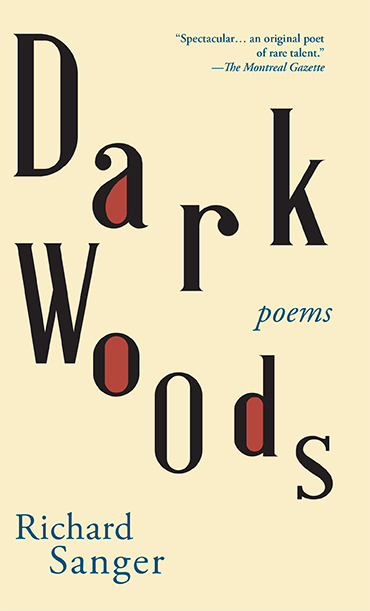
I'm even more chuffed to see Richard Sanger's Dark Woods on Orr's list. Not only because Richard is a friend and the book is published by Biblioasis, but because I was its editor. I don't care a whole lot about attention or lack thereof paid to my own books, but I always get a bang out of seeing the books by others that I love appreciated.

Thursday, November 8, 2018

CBC Poetry Prize

I'm doing very little freelance work these days because I'm doing a lot more other work than I used to, but one thing I did recently was serve as a reader for CBC's annual poetry contest. It's a complex process, with twelve readers each assessing over 500 entries (I read 515) and submitting a list of their top 12. There is some overlap, as I understand it--i.e., there aren't 6000+ entries, but over 2500--so they must aggregate the lists somehow to come up with their longlist of 30, which is then whittled to a shortlist of 5, before a winner is finally crowned. Three of my picks made the longlist, including my top pick, a poem called "Migrations" by a poet named Mark Wagenaar, who also had another entry make the longlist. I only learned the identity of the author when the list was published, because the judging is completely blind. Wagenaar's name and work wasn't known to me (which shows how little attention I pay to these contests normally, since he won it in 2015) previously, so this was one of the bonuses of doing this work. Wagenaar's poem, I will say, was easily my first choice, so I was disappointed that it didn't make the shortlist. But so it goes with contests.

Tuesday, November 6, 2018

HALF


Having, by any actuary's reckoning,
logged half the days due me, here I hunker
in the chilly gloom of my third mortgage,
shivering and doubting the wisdom of this dead
pledge: petty rent-seeker and prompt payer
of bills, fetcher of foodstuffs, keeper of the dulled blade
of concupiscent bliss, alchemic converter of hours
into shekels deferred for the decades
ahead. When did I grow so prudent,
when tripped I over the threshold
dividing fresh from old, when did contingent
thoughts lodge, throttle and square this cold
shoulder to the wheel? Numb and dumb,
I hold a lit candle to my quivering palm.


I hold a lit candle to my quivering palm
and marvel at the metacarpals dark
against an orange lantern glow—then jerk
the hand aloft before the skin begins
to sizzle. Had pain the power of a balm
to turn tortured thought away from work
and aim it on the path of art or at some mark
more worthy than the burthens of a citizen,
then might I persist, burn black the skin,
obliterate the fortune-teller's lines
and bear the molten stigma like a blaze
while I wander nameless among pines
and cedars, unheeded prophet of unknown
gospels, wending along dim holloways.


Gospels of wind along dim holloways
blow, and no prophet there to hear them;
footsteps on the stone of cthonic hallways
echo, and no homeless there to fear them;
pastures abandoned to spruce and grey jays,
with no pioneer's handsaw to clear them;
directors stage cycles of mystery plays,
but no audience shows up to cheer them;
councillors conspire to deflect sun's rays,
and no activists gather to jeer them;
slouching toward man's penultimate days,
like Zeno, we can only draw near them—
My friends, this is the way the world ends:
nothing is shattered, but everything bends.


Nothing is shattered, but everything bends
beneath the weight of airborne drops of ice.
Birches bowed over the track scrape ends
on this train's steel and glass as we pass
through a light-latticed tunnel. No passengers
sit in the dome to take in this marvel;
they're all in the wifi zone, tapping messages
of all-caps outrage at the late arrival
announced, wailing like Lear at the weather.
A heavy branch glances off the glass dome.
I flinch, but settle into the leather
of my seat, bound to wait this out. Bound home.
Half of my days are spent away
in a limbo zone between go and stay.


In a limbo zone between go and stay
is where our hero finds himself at home,
less foreign, least strange; starring in a staged play
on steel wheels, your working-class-hero-cum-
boho-hobo-cum-minor-magnate struts
and frets, stumbles, sways, lurches and lunges
through the switches, crossings and slack action
of his days. Gravity and inch-high flanges
keep this rolling show on rails gauged to ruts
in Roman roads, which is to say the way
is wide as two horses' rumps, a fraction
of which—one half, I'll own—you'd fairly say
our hero is, bytimes. Bytimes, he earns
our trust and love. Bytimes, he even learns.


Trust and love, bytimes, even I have learned
to honour, however strange they might be
to my soul—a notion I've a half-mind
to dismiss, since soul is nothing I can see,
flipping by-catch in a neural net designed—
if that conceit my judgment might concede—
to keep this body breathing. I have yearned—
yea, even burned—for purpose, for meaning
beyond bare-forked, basic need to light me
down this darkling road toward gold-greening
rolling fields, clear streams and feral orchards
dropping windfall fruit free for my gleaning—
but snap back from dreaming to data and facts.
No haphazard drift can sanctify profane acts.


No haphazard drift sanctifies my profane acts,
therefore have I made this drift my mission
statement to the stars, whose distant fission
fuels my hours and lifts dim cataracts
of mist from the bustled harbour narrows,
above which sit my debt-beleaguered homes.
The water and the interest rate arrow
ever upwards, precipitation comes
slashing crabwise at my asphalt shingles,
unraked rotting leaves festoon the flower
beds. Across the Northwest Arm, the Dingle
Tower pokes through fog. Church bells toll the hour.
The balance of my days are beckoning—
Half, by any actuary's reckoning.


Sunday, April 1, 2018

Charlie Sark reads Ego on the full moon

I'm honoured to have a poem of mine, "Ego," read by PEI/west coast poet and chef Charlie Sark as part of this cool chain project, "Luna Mouths," in which an east coast poet records a poem by another east coast poet and posts it on the night of the full moon.

Monday, March 12, 2018

Sunday, January 28, 2018

RIP Rosaleen Dickson

Surveying the sad state of affairs that's dominating the news in Canadian writing circles these days, it's easy to forget the good and valuable things that make participation in this often dysfunctional sphere worthwhile.
Almost eight years ago, The Porcupine's Quill published The Essential Kenneth Leslie, a book I edited which brought a substantial selection of Leslie's work back into print for the first time since the late '70s.
In the process of working on that book, I got to know Leslie's daughter, Rosaleen Dickson, and her daughter, Elizabeth Dickson, who was working on a biography of her grandfather. It was easy to see that Rosaleen had inherited several of her father's remarkable qualities: charisma, wit, rhetorical flair, leadership and pro-social political commitment.
One of the great joys of my literary life was having Rosaleen and Elizabeth attend the Ottawa launch of the book. At that event, John MacDonald took this wonderful candid photo of me and Rosaleen in conversation.
I learned from John the other day that Rosaleen had died, age 96. Elizabeth told me that, while her mother was physically infirm in the last year of her life, her radiant brilliance never dimmed. This obituary notice gives some indication of what an exemplary life she led.
Seems appropriate to conclude with one of her father's poems:


Requiescam
I must have peace, must have it undisturbed,
quiet and deep, must have it in my soul,
deep in my soul. But let no noise be curbed,
let every restless thing escape control
and find its freedom in its own sweet groove!
Let eagles storm the sky, let the worm creep,
let all things move the way that they must move,
but let me rest awhile and let me sleep!
And do not chide me for my weary eyes,
nor scold because my hands have lost their grip.
Some arrows they have aimed still climb the skies,
some hands shall not for get their comradeship.
I must have sleep and leave the quickened clay
to answer if sleep bring another day!

Thursday, November 9, 2017

Wells and Lebowitz, Best of the Best

A bit late with this "news," but hey, I haven't posted anything since February, apparently, so I'm sure no one's keeping track anymore...

This year, Tightrope Books has published, for the 10th anniversary of their Best Canadian Poetry in English series, a selection of 90 poems from the previous nine years. Molly Peacock and Anita Lahey have kindly included my poem "One and One" and excerpts from Rachel's Cottonopolis sequence. We recently got our contributors' copies and there are many other fine works included, no surprise.

This poem of mine has proven to be quite successful, as poems go, which is further proof that there can be no formula for writing "good poetry." As I said when I first posted it on CLM, I'm at a loss to account for where it came from or what, precisely, it might mean. Its cycling syntax and basic diction seem to have broken the Poetry Assessor machine, which scored the "One and One" at 9.4, which, I was told by the person running the Poetry Assessor's Twitter account, is--or was at the time--the highest recorded score for any poem run through the Assessor's software. FWIW, caveat emptor, etc.

Thursday, February 16, 2017

Commentary on "Waypoints" recital

I just came across an unfortunately lukewarm review of last month's recital. But hey, no press is bad press, etc. I have an obvious bias, but I don't really hear any "Broadwayish" elements in the composition. Ah well.

Monday, January 30, 2017

Toronto performance of "Waypoints" song cycle

If you're in Toronto during the day tomorrow, I hope you will attend the latest performance of the song cycle "Waypoints," lyrics by yours truly, scored by Erik Ross, sung by Phillip Addis, accompanied on piano by Emily  Hamper.

Sunday, January 29, 2017


I read The Dark Is Rising to my son.
Outside, the dark has risen with passionate
intensity and weak light contends to gain
conviction. The falcon veers back late,
alights upon her master's sleeve; rooks
gather and agglutinate; an unseasonal
skein of geese thrums south, wing-
beats synced to distant drums. Meanwhile
the centre holds. And holds. And mutters
its appeasing song: We are better
than this, we will not be brought low, we must
save our strength for the fights that matter
most. But the darkness is upon us, son,
and throngs midwinter's gibbous moon.


Monday, January 23, 2017

Don Coles, on rhyme


If that search for the rhyming sound to end your line with, that clink that locks the rhyme in, isn't a true search, i.e. if it doesn't send the shaft down to the deepest level this poem you're working on can live at, deeper than you could have reached without this self-imposed rhyme-search, then you stopped digging too soon, you accepted a word merely because it rhymed, it simply slid into place without making anything new happen; and if this occurs even twice, no, even once, your poem's probably already dead in the water, it's already, flottaison blême et ravie, lost to human sight.

Friday, November 18, 2016

Due Process

I haven't said a lot about the ongoing FUBAR of Steven Galloway's firing from UBC. I haven't said much because I'm not that invested in what is euphemistically known as the "literary community" and, frankly, because I don't know much about the case. Nobody except those involved does--for mostly very good reasons. Like the law. Near-perfect ignorance, of course, hasn't stopped a lot of other people from having strong opinions about how things have gone down. And then, a horribly misconceived letter started circulating, signed by all manner of CanLit luminaries, who, despite knowing next-to-nothing, thought that it was incumbent on them to grease the wheels of justice. Unacknowledged legislators, antennae of the race, etc. When it was pointed out by other writers that this anonymously authored letter was markedly biassed towards Galloway and threw his accusers under the bus, a number of writers, horrified that they had been blindly duped into condoning rape culture (because they are apparently not so good at reading, even though they do it for a living), scrambled to remove their names from the letter. Others, including Margaret Atwood, who is looking more and more like Signal and less and less like Noise, have dug in their heels.


One thing I do know about this matter is that Mr. Galloway's dismissal is the subject of a grievance being pursued by his union. This is what due process looks like in a unionized workplace. I know, because I'm a shop steward in my union local (Unifor 4005) and I write a LOT of grievances, for matters both minor and grave. (These days, I write more grievances than anything else, unfortunately. I could tell you some stories. Except I can't. Because it's private information and all.) It's not a perfect process and it can take a godawfully long time for the grievance procedure to resolve anything, but if/when employer and union fail to work things out on their own, the matter will go before an independent arbitrator, who will render an impartial, and binding, judgment. In my experience, arbitrators get it right far more than they get it wrong. This is because they weigh all available facts and arguments in a detached and rational manner. And they get it right far more often, I guarantee you, than dozens of self-righteous writers flailing about rhetorically.

Yesterday, I came across a rare beam of light, in the form of a Facebook post by a writer named Dorothy Palmer. She says pretty much all that needs to be said about this shitshow.

Tuesday, November 8, 2016

Blurble blurble

Jason Guriel on the lowly blurb. Like him, I've had reviews I've written misappropriated and manipulated by publishers to appear more praiseful than they were. Dirty pool, but you have to tip your cap, I suppose. 
On the few occasions I've been asked to furnish a pre-publication blurb, I've declined, for many of the reasons Jason touches on: a)I'm not famous enough--not nearly!--to boost your sales. b)The blurb is a seriously degraded currency and I don't wish to contribute to its further decline. c)I probably won't have sufficiently unmixed feelings about the quality of your book to blurb it with wholehearted enthusiasm. 
My own books of poetry have gone without blurbs, by my own wishes. The last two, we've gone with the full text of a poem, since what can tell a reader more about the contents of a book than a representative sample? I very nearly got one from Barry Lopez for my first book, but it arrived after the book had already been published. Best kind of blurb: from one of my literary heroes, but not out there for the public to see. For my book of essays, I pulled a Zizek and selected something never intended to be used for that purpose: a dismissive couple of sentences from an interview with George Bowering, who was apparently unimpressed with my reviewing work, but took too many pains to demonstrate how little he cared for it.


Monday, September 19, 2016

POEM IN SEPTEMBER


First rain in five weeks—
sumac and creeper aflame
spreading asters bloom
tire treads ripping wet asphalt.


Tuesday, September 13, 2016

Interview posted

Of all the things I've written in my life, I don't know if anything's received more attention than the short article I wrote for The Walrus recently on real estate and related matters. This morning, Ryerson University's radio station aired this interview with me: