Lisa Robertson on Meter
Counting syllables really trained me to carry my ear down to that micro level of attention. I spend a lot of time counting syllables. For a while I had to stop myself from counting syllables when people spoke.
Counting syllables really trained me to carry my ear down to that micro level of attention. I spend a lot of time counting syllables. For a while I had to stop myself from counting syllables when people spoke.
Brian Campbell has reviewed Career Limiting Moves, the book, for Rover Arts. Check it out.

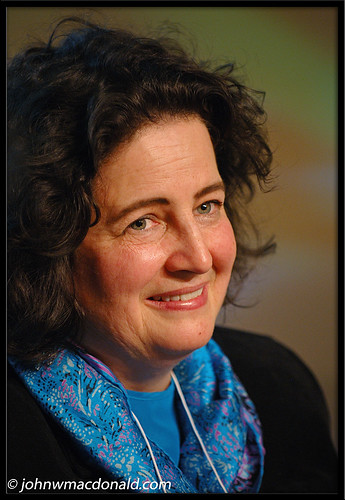 I learned yesterday that my dear friend Elise Partridge has died. I knew her time was running out--I'd known it for almost a year--but I was really hoping she'd hang in long enough to see her final book come off the press this spring. Knowing this was coming in no way makes it less painful for those who knew and loved her--for me--but given how much pain and suffering she'd already been through, there is some comfort in the thought that she need endure no more of it.
As word got out about Elise's death on social media yesterday, many people wrote of how kind she was. And she was. Elise wasn't that awful thing--a "nice" person--she was a person of great spirit, authentically generous in a way that no nice person is. I first met her, briefly, in March 2006, when I did a reading in Vancouver. She introduced herself to me after the reading, said a few enthusiastic words and, as I recall, left precipitously. She seemed unaccountably anxious. Not long after, I had an email from her apologizing that she was "ridiculously shy when meeting new people." She said a few lovely things about my poems and about my review work. And her comments weren't merely perfunctory compliments, of the sort one encounters all too often in any collegial environment, but the kind of sharp, perceptive observations that can only be the product of thoughtful attention. Not long after that, Elise wrote to offer me a complimentary subscription to the London Review of Books, a perk her husband Steve (a medievalist in the UBC English department) had acquired in exchange for writing a review for LRB. She thought, rightly, that the high quality long-form reviews in LRB would appeal to me.
When I moved to Vancouver from Halifax the following year, Elise did more than any other person (outside of Rachel's family) to welcome me to the city. She invited me to become a member of the Poetry Dogs, a semi-regular reading circle that would meet at a member's house to discuss whatever poems people had brought along. Members, besides Elise and Steve, included Barbara Nickel, Stephanie Bolster, John Donlan, George McWhirter, Christopher Patton and, later, Matt Rader. The only condition was that they had to be someone else's poems, someone not a member of Dogs. It was in Dogs sessions that I really learned how acute and uncompromising a reader Elise was. Anyone who came under her tutelage--as when she was poet-in-residence for Arc Poetry Magazine--could only have come away with their poems much improved.
Elise was someone who was more intimate with death than anyone in the First World should have to be, but something that distinguished her personality, and the poetry that was so much a product of it, was her refusal to be gloomy in the face of death. She would never have agreed with Larkin that "death is no different whined at than withstood." And she never succumbed to despair. Her oeuvre is full of poems about death, but they are playful, virtuosic poems, acts of resistance, testament to the size of her spirit, the defiance of her breath.
In an early email to me, she was irked by a reviewer who had "insulted [her] character and artistic integrity by charging [her] with 'trying to dazzle.'" She ended that letter with a piece of advice for me: "If you ever get slandered with the show-off label, my suggestion is to reply, 'I'm not TRYING to dazzle--ah just DOES!'" And she did. I miss her already, but she has left so much behind.
The index of a vintage
is the season's history: how many
photons have fallen
through the skin. Equations
predict excellence. Unlike
the nose of connoisseurs,
the maths involved
are flawless, however
maculate the soil.
Deprive the vine of water,
it will eke its taproot deeper
down through solid strata
where it draws not only
succour for the turgor
of its foliage and fruit,
but hauls up half-formed
metaphors from minerals
lying latent in the clay,
imparts them to the grape
flesh where they mingle
and intensify as the sun-
washed clusters ripen.
These metaphors remain
embryonic until tongue
-cognized and -constituted
by a seasoned sommelier
who nearly knows them flawlessly.
The index of a vintage,
however reason may explain it,
retains intrinsic mystery—
the grape escapes its proof.
As it very seldom happens that the rage of extemporary criticism inflicts fatal or lasting wounds, I know not that the Laws of benevolence entitle this distress to much sympathy. The diversion of baiting an author has the sanction of all ages and nations, and is more lawful than the sport of teasing other animals, because for the most part he comes voluntarily to the stake, furnished, as he imagines, by the patron powers of literature with resistless weapons and impenetrable armour, with the mail of the boar of Erymanth, and the paws of the lion of Nemea.-Samuel Johnson
My old friend Mark Sampson has also included CLM in his ten favourite books of 2014. Thanks, Mark!
I'm not a big fan of book-biz year-end best-of lists in general, but there are better ways it can be done. Brian Palmu has listed his favourite books of 2014, but, refreshingly, these are books he read this year, rather than books published this year. He also doesn't stop after he's reached an arbitrary number of "best books." And, pleasingly to this household, he has included my book of essays and Rachel's Cottonopolis.
Welcome to your turnkey cul-de-sac,
where faux Tudors and ersatz cedar-sided
colonials sprawl cheek by jowl, and back
on a hemlock-shaded ravine: your own private
wilderness oasis and buffer against the berm-
baffled traffic beyond. This ticky-tacky
facsimile is the acme of blandeur:
gauche rooflines, cultured stone and off-the-rack
opulencies galore—all the doo-dads
and knick-knacks the status anxiety
of your executive lifestyle demands,
and priced to move fast. This high society
dream could be yours, but it won't last.
Our poems are conversations in every meaningful sense. They are an exchange between ourselves and those parts of ourselves that belong to other people. Intimate whisperings, productive tensions. They challenge and tease us, lead us to say things that we have not thought to say. They gives the courage to have a self and to lose it too, which is surely the most we can ask of any conversation.
...
We are made up of voice and we are the relations between voices, inside and out. They are our judgement and our redemption, our ipseity and our selflessness, our origin and our promise. Perhaps their revelation is possible in real conversation. It may be, after all, what we live for. As Yeats says, "what do we know but that we face / one another in this place?" I suppose there will always be something ethereal and unreal about conversations as long as I feel as anxious about them as I do. But in every ghostly encounter--the ones we have with friends at Tim Hortons and the ones we listen for when we write--we recognize the voices we love and think: it is good of them to come back the way they do and share a part of themselves with us, good to hear them again. And our hearts warm to a quiet tryst of living voices, ones that, if we are lucky, will choir among themselves long afterward.


 Over on the Biblioasis blog, Amanda Jernigan has contributed a few words in praise of my book Track & Trace. It's nice to hear anyone appreciate my work, but it means an awful lot coming from Amanda, who is a superb poet in her own right and one the very best readers of poetry I've ever met. Nice also to hear her appreciating Seth's contribution to the book. I still can hardly believe I published a book designed by him. I'm a lucky fella.

Expectations also affect your perception of taste. In 1963 three researchers secretly added a bit of red food colour to white wine to give it the blush of a rosé. They then asked a group of experts to rate its sweetness in comparison with the untinted wine. The experts perceived the fake rosé as sweeter than the white, according to their expectation. Another group of researchers gave a group of oenology students two wine samples. Both samples contained the same white wine, but to one was added a tasteless grape anthocyanin dye that made it appear to be red wine. The students also perceived differences between the red and the white according to their expectations. And in a 2008 study a group of volunteers asked to rate five wines rated a bottle labeled $90 higher than another bottle labeled $10, even though the sneaky researchers had filled both bottles with the same wine.It isn't hard to translate these results into poetry world terms; it's no stretch to imagine showing a group of Canadian poetry lovers the latest "Don McKay" poem (actually written by someone else) and then to watch them finding six ways from Sunday to praise its virtuosity. Or, conversely, to imagine McKay sending his own new poems off to magazines under a pseudonym and getting most of them back with polite rejection notes. We don't have to imagine it, because similar sociological experiments have been performed. In a later section of his book, Mlodinow writes of an experiment with pop music:
The popularity of individual songs varied widely among the different worlds [the experiment involved dividing 14,341 participants into nine "worlds," each of which was given different popularity data for a selection of forty-eight songs by bands unknown to the participants; the ninth group received no popularity data at all], and different songs of similar intrinsic quality [as defined by the ninth world's rankings of the songs] also varied widely in their popularity. For example, a song called "Lockdown" by a band called 52metro ranked twenty-six out of forty-eight in intrinsic quality but was the number-1 song in one world and the number-40 song in another. In this experiment, as one song or another by chance got an early edge in downloads, its seeming popularity influenced the shoppers. It's a phenomenon that is well-known in the movie industry: moviegoers will report liking a movie more when they hear beforehand how good it is. In this example, small chance influences created a snowball effect and made a huge difference in the future of the song.
I was watching late-night television recently when another star ... appeared for an interview. His name is Bill Gates. Though the interviewer is known for his sarcastic approach, toward Gates he seemed unusually deferential. Even the audience seemed to ogle Gates. The reason, of course, is that for thirteen years straight Gates was named the richest man in the world by Forbes magazine. In fact, since founding Microsoft, Gates has earned more than $100 a second. And so when he was asked about his vision for interactive television, everyone waited with great anticipation to hear what he had to say. But his answer was ordinary, no more creative, ingenious, or insightful than anything I've heard from a dozen other computer professionals. Which brings us to this question: does Gates earn $100 per second because he is godlike, or is he godlike because he earns $100 per second?
After missing the last couple of years, I was back at UNB's annual Poetry Weekend this year and brought my digital recorder with me. I was there with Rachel and our son, so part of the weekend had to be dedicated to kid-friendly activities (as Kaleb said to me when I suggested he might listen to my reading, "But daddy, that would be BORING!"), so we missed the first set of readings on Saturday. I've uploaded the other five recordings to Internet Archive.


Jailbreaks: 99 Canadian Sonnets is one of the best anthologies of poetry I know, and in my top five contemporary poetry books ever. Zach Wells selects sonnets from across the country, across generations, and across styles. For those who think sonnets all look the same, there is much to learn here about the range of poetic possibility within a single set of formal constraints. Among other clever things, Wells's introduction argues that the fourteen lines of the Petrarchan and Shakespearean sonnet forms are poetry's finest vehicle for introducing, developing, and concluding a well-formed thought. These poems are thus phenomenological jailbreaks, consciousness busting out -- in good order -- from the buzzing prison-yard of our jumbled minds. A book to dip into or read cover to cover, with delight on every page.


