Wednesday, April 16, 2008

Elise Partridge

Here's an interview with Elise Partridge, from the Walrus blog. Elise is someone I've got to know--and like a great deal--since moving to Vancouver. I find it interesting that she says that Canada is more hospitable to metrical rhyming poetry than the States. My impression has been the opposite. I can't imagine an American poet such as Richard Wilbur, for instance, becoming the Big Name he is in Canada, where poets like George Johnston and Richard Outram worked in obscurity and where as fine a poet as Charles Bruce has been all-but-forgotten. I reckon Vancouverite Daryl Hine would also dispute Elise's observation. By contrast, it seems as tho Black Mountaineering has been a more popular sport in Canada than in its country of origin.

I haven't read Elise's new book yet, but her first collection, Fielder's Choice, has some really excellent poems in it. What I particularly like about Elise's work is the balance of playful humour and poignant emotion in it, both modulated by a very fine verbal precision, which is, as others have noted, reminiscent of the work of Elizabeth Bishop.

Here are a few more links:

"One Calvinist's God" - Arc's How Poems Work

"Buying the Farm" - Maisonneuve

"Two Cowboys" - The Walrus

"The Runt Lily" - Poet Laureate's Poem of the Week

Three Poems - Poetry Daily

"In the Barn" - Washington Post

"Elegy" - Slate (with audio)

"For a Father" - Writer's Almanac (with audio-scroll down to the bottom)

"Supermarket Scanner" - Writer's Almanac (with audio-scroll down to the bottom)

"Rural Route" - Writer's Almanac (with audio-scroll down to the middle)

"Chemo Side-Effects: Vision" - The New Yorker

"First Days Back at Work" - The New Yorker

"Plague" - from a wildflower website


Tuesday, April 15, 2008

Wedding Report

We had the finest day of the spring on Saturday for our wedding and it was a wonderful night. A short, sweet ceremony, officiated by marriage commissioner Bob Buzza, very good food, plenty of drink (the beer keg ran dry, but more than half the wine I made was left at the end of the night), and most importantly good friends and lots of family. Rachel's mom and my mom both gave very funny speeches, part toast, part roast. Rachel and I have been married for several years already, and we exchanged rings three years ago, so this wasn't a life-changing event, but it was a very life-affirming night. Many photos were taken, but I've yet to see any.

It was great having my mom and brother in town for a few days, too, all the way from PEI. We made many outings, giving me a chance to do some of the touristy Vancouver stuff I wouldn't normally do.

Rachel and I are heading over to Ucluelet (western Vancouver Island) on Saturday for an extended weekend "minimoon." We're staying at Terrace Beach Resort, owned by Jason Priestley of Beverly Hills 90210 fame.

I'm doing a reading on the 25th, with John Donlan and Rhea Tregebov, hosted by the Dylan Thomas Circle of Vancouver. Here are the details:

Time: 7:30
Place: Red Dragon Pub (downstairs at the Welsh Community Centre)
215 East 17th Ave.

All of us will be reading a Dylan Thomas poem as well as some of our own. Should be good fun.

And on Tuesday the 29th, we're having the Vancouver launch for Jailbreaks: 99 Canadian Sonnets. Have you got your copy yet? Reading at the launch will be myself (reading sonnets by Vancouver-area contributors who couldn't make the launch), Crispin Elsted, Nancy Holmes, George McWhirter, Lyle Neff, Barbara Nickel, and Anne Stone (reading a sonnet by the late Robert Allen). Here are details on the launch:

Time: 7 pm
Place: Our Town Cafe
245 East Broadway

Hope to see you Vancouver types out.


Wednesday, April 9, 2008

Hiatus

I'm getting married on Saturday and my mother and brother are in town, so don't expect much here for the next little while. And if you think I've got anything to say about the Griffin Prize Shortlist, as far as I'm concerned I already said it...

Monday, April 7, 2008

Canada's Poetry Capital?

A while back, Glen Rotchin asked me for my input on a piece he was writing about a national poetry capital. His article appeared in the Montreal Gazette the other day.

Saturday, April 5, 2008

Bwahahhahahaha!


READ THIS


Friday, April 4, 2008

Maureen Medved, Teresa McWhirter, Sachiko Murakami

Rachel and I went to the Robson Reading Series last night.

First reader was Maureen Medved, who read from her now-film-adapted novel The Tracey Fragments. I had trouble getting into the excerpt she read, but it built momentum as she went and was on the whole pretty persuasive. Couldn't help thinking, tho, that it would work better as a film. It was interesting to learn in the Q&A that followed that Meved, who is also a screenwriter, adapted the book herself and initially conceived of it as both novel and screenplay. She also read a scene from a novel-in-progress, which I couldn't get into at all.

Teresa McWhirter next read from her new novel Dirtbags. The writing was pedestrian and the reading too short to tell if the story had any more redeeming features.

The last reading was by Sachiko Murakami. I first met Sachi back in 2004, I think, in Montreal, after the Unsettled launch I posted recently. She told me she appreciated the references to Vancouver's downtown eastside in my poem "Jake." And now her own book about that much-maligned and oft-benighted borough, The Invisibility Exhibit, is out with Talonbooks. The book works around the story of the missing women from the downtown East Hastings area that has of course been a major national news item for some time now.

I wrote recently about the ham-handed political poetry of another Vancouverite, Rita Wong. A backchannel email I got interpreted this as a general dismissal of political poetry as art. Which it wasn't. But the most common problem with political poetry is an imbalance in the rhetoric and artistry, resulting in poems that have, in Keats' phrase, "a palpable design" on the reader, and I felt that Wong strayed repeatedly over the line between art and propaganda. What I've seen and heard of Sachi's book so far suggests she is aware of this as a potential problem, and has done her best to avoid it. I bought the book last night and look forward to seeing for myself--even if Sachi jokingly asked me not to review her!

Wednesday, April 2, 2008

Old Audio

Was going thru a box of CDs and found the recording of the Montreal launch of Unsettled, dating back to October 21, 2004. If you're at all interested, you can hear it here.

Tuesday, April 1, 2008

A Change of Heart

I know this will probably come as something of a surprise--if not a shock--to regular readers of this blog, but since the conception of my future child I've gradually come to realize that many of my views are ill-considered. When this child is born, I don't want it to grow up in a moral vacuum and I want it to have some sense of the purpose of life. These are very hard things to manufacture with secular scepticism. I can hardly believe I'm saying this, but I've decided to get baptised in the Anglican Church and raise our child as a Christian. Lord know this won't be a solution to all the adversity he or she encounters in life, but it will give him or her something I never had: a firm foundation.

[Well, it's after noon now, so yes, Ian, April Fool's!]

Monday, March 31, 2008

Reviews Online

My reviews of Randall Maggs' Night Work: The Sawchuk Poems and Tim Lilburn's Orphic Politics are now online at Quill & Quire.

Sunday, March 30, 2008

Anonymous praise for Hannus

This lovely little blurb appeared on the Pedlar Press Facebook page:


From Another Pedlar Author
"About HANNUS by Rachel Lebowitz"

Been rereading Hannus for the past 2 days on the subway on the way to work (working at Penguin at Yonge and Eglinton. . .) I think Rachel L. is such a beautiful writer. Music, really. No point turning on the radio when you got words like that coming out of a book.

Zuppa Circus

Rachel and I braved the hail and sleet last night to see the closing night of Zuppa Circus' show Penny Dreadful. Zuppa Circus is an ensemble theatre company from Halifax. Three of its members--Alex McLean (director of this show), Sue Leblanc and Ben Stone--are people I knew slightly when I was in university. Alex has also done quite a bit of work with my cousins Ker and Jane in their Number Eleven Theatre. The ethos of this type of theatre is collaborative and interdisciplinary, building plays together (and adapting them as players come and go from the company) and incorporating elements of dance and music into the drama; it favours an intimate relationship with the audience over the fourth-wall separation of the proscenium stage. It's a kind of avant-garde theatre thoroughly steeped in tradition.

Penny Dreadful is described thus in the publicity:

1863. Mice are gathering under the floorboards on a wealthy Halifax estate. In the servants’ quarters, Charlie is setting traps while Adelaide, the drunken scullery maid, has delusions of sainthood. The two servants become the fascination of their employer’s wayward son, home with stories of travels in strange lands. A love triangle develops, driven by greed, temper and a perverse sense of destiny, culminating in a violent murder and public hanging.

Minimally staged, with an intimate audience/performer relationship and a live musical score, Penny Dreadful is a tale of revelation and love in the age of syphilis.

The show was fabulously riveting. Tight script and pitch perfect performances of vividly realized characters. It wasn't as audacious as some Number Eleven shows I've seen (particularly Icaria, much of which is performed on stilts), but it wasn't the sort of script that called for that sort of audacity. Spare and fraught with emotional tensions, the four-person cast and the minimalist set were just right. If Zuppa Circus comes to your town, do yourself a big favour and get out to see them. If they're not coming to your town, invite them!


Friday, March 28, 2008

Jailbreaks Update

The proofs have been finalized and shipped to the printers and now, ladies and gentlemen, we have a cover design for my sonnet anthology, Jailbreaks. I think it's very handsome. If you'd like to buy a copy--as I'd like you to--there are links on the right to various online retailers. Ordering it from your local is of course always a noble thing to do.

Thursday, March 27, 2008

Suzanne Buffam

Just read this interview with Suzanne Buffam, in which she is, as always, charming, wry and insightful. Her Past Imperfect is one of the best first books I've read and on the whole a damn fine collection. Her poem "Meanwhile" is included in Jailbreaks. A much-delayed review of PI I wrote should be appearing on the CNQ website in the hopefully not too distant future.

In the meantime, you can check out these three poems. The first one is, I think, my favourite of hers.

Wednesday, March 26, 2008

How to Get Your Stats to Spike


I just took a look at my stats and did a double take when I saw that traffic for today was 7 or 8 times higher than it usually is and that my total for the day--before 1 pm!--had pretty well doubled the next-busiest day. A little closer look reveals the true cause of my newfound popularity. Go figure, people are more interested in naked women than poetry...

Tuesday, March 25, 2008

RHYTHM


Burlap sacks of shorn wool, pungent
Cushions in the porch on which

To perch and tie a boot, until,
Unstuffed, soaked in the tub, hung up,

Carded into batts, pinched and twisted
On the bobbin to the treadle’s

Metric creaking, wound up in skeins
And clews, strung through heddles

And levered by pedals to let
Pass the shooshing shuttle through

The warp to form a weft—or purled
And knitted into patterns, into

Socks and toques and mittens, scarves
And gloves and sweaters, to the metric

Clicking of the needles as my
Mother counted stitches in a row.


Wednesday, March 19, 2008

Off-line

I'm going to Lasqueti Island for the long weekend to celebrate the death of Christ and eat a rabbit or two. TTFN.

Monday, March 17, 2008

Pacific Festival of the Book, etc.

Got back today (Sunday) from my weekend in Victoria. And a fine weekend it was, if not the best weather for interurban motorbiking.

Friday night, after having a drink and a good chat with my friends Harold and Amy, recent émigrés from Montreal who generously put me up for the weekend, I footed across the bridge from Esquimalt into Victoria to see another friend Mathias Kom, whose band The Burning Hell was playing a gig at a café. I've said it before in these virtual pages and I'll say it again: I love Mathias' songs and I love the way he sings them and how the band, in its ever-shifting configurations, plays them. What I loved less was the film, Chronic, that was screened after the music stopped. Chronic is a 45 minute story of hapless potheads in Peterborough, ON, scheming to score pot, sell pot, and scam other people selling pot. There were a few bright moments, and a couple of Burning Hell songs were in the soundtrack, but not a work of cinematic brilliance.

Saturday morning, I rode back into Victoria to attend the events at the Pacific Festival of the Book. I showed up at 10:45, in what I thought was plenty of time to catch Peter Trower's reading, which I'd been told was going to be at 11. I walked in and saw Pete signing books. I said hi and asked him when he'd be reading. He said he already had, at ten. This was somewhat symptomatic of an overall problem the festival seems to have had with organization and communication. Pete's reading shouldn't have been so early on a Saturday morning; he came all the way over from North Vancouver, only to read for five people. Another problem was that it was very hard to actually find out who was reading where and when, as the website for the festival didn't have any specifics [update: I just figured out that, although the downloadable PDF "full schedule" doesn't have details, the "schedule at a glance" does list what happened when; a problem of terminology, methinks]. Hard to say how many more people might have come had it been more effectively publicised.

At any rate, there was a very professional-looking glossy printed program, which I picked up on entering, so I consulted it to see what all was going on. And I noticed that my old friend Peter Richardson was reading at 12:30 (which might have been a better time for Peter Trower's reading). Until he retired from Air Canada and I quit working for First Air, Peter R. and I were probably the only two baggage-handling versifiers in the country. I wasn't even aware that he was part of the festival, so this was a very pleasant surprise. He wasn't supposed to be originally, but when Chris Patton backed out due to other commitments, Vehicule Press sent Peter in Chris's stead. I love Peter's work, so full of verbal brio and playful wit, and I picked up a copy of his third collection, Sympathy for the Couriers, which I'm really looking forward to spending some time with. Unfortunately, Peter was reading with two much less skilled poets, all three crammed into a half-hour (from introductory bio notes to get-the-hell-out-so-the-next-event-can-start. Another example of slipshod organization.

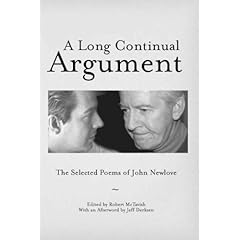
I also spent some time in the festival's exhibition hall, browsing the tables. I picked up what looks to be a very interesting issue of The Pacific Rim Review of Books, featuring an interview with, and review of, Robert Bringhurst, as well as a review of John Newlove's A Long Continual Argument, and much else besides. I bumped into John Barton at The Malahat Review table and we had a good chat about the perfidy of publishers and other writerly complaints.

At 1, I went to what was supposed to be a talk by Robert Bringhurst on "The Art of the Book." Robert started off saying that he was told he'd be doing a reading, not a lecture (yet another gaffe), and apologised to anyone who had come hoping to hear a lecture. He did present a beautiful handmade edition of a polyphonic poem for three voices he'd written. It's hard to describe the thing, but basically it consists of four books, one for each voice and one containing notes and other para-textual things. The individual books fold out from the centre, so that each speaker might stand around the book reading his or her part; the individual books can also be detached, for greater ease of performance. Really neat piece of work. At any rate, after the show and tell, Robert read some excerpts from his two recent prose works (which regular CLM readers know I can't recommend highly enough) as well as a good clutch of unpublished poems, which were very fine.

After Bringhurst's lecture/reading, PK Page was supposed to read in the same room. But a festival volunteer made the sad announcement that Ms. Page was ill and unable to attend. I wasn't the only one disappointed by this news; I only hope that the illness isn't serious. Page is around 92 now, so any talk of sickness can be scary stuff. The volunteer said that if there were any other poets in the room who'd like to read, the room was free for half an hour. I figured what the hell and volunteered. So did Peter Richardson. Only five of the dozens who'd come to hear Page read stayed, so it was an intimate little event, but the audience made up for its smallness in attentiveness, and I actually peddled a copy of Unsettled. This sort of thing is why I almost always have a copy or two on me.

After saying goodbye to Peter, I got back on the bike and headed down to Frog Hollow Press to pay Caryl Peters a visit. I was almost out of copies of Achromatope, so I figured I'd take advantage of being in Victoria to pick up a fresh supply. Caryl told me that it hasn't been selling all that well, even if better than some of the broadsides she's done. She's talking about getting out of doing broadsides altogether, because there's so little apparent interest in them. The problem is, I think, that the authors aren't doing their bit to move them. It's hard to persuade someone to order a collectible piece of literary art sight-unseen. You've got to show it to people, live, in order for those people to realize it's something they might want to own. Anyway, I picked up 25 copies, and I know that, given enough readings, I'll move them all and order more. The relationship between a writer and a specialty private press like Frog Hollow really has to be a collaborative one. You can't just let them print your work and then do nothing to help the work find an audience. And why Frog Hollow wasn't invited to the PFB, I can't imagine, but given the other oversights and errors, I'm not surprised.

From Caryl's, I headed back to Esquimalt, where I had a beer with Harold before heading back over to Victoria to meet up with Steven Price, his brother Kevin and Steve's partner Esi Edugyan. After a glass of wine, we went out for a delicious sushi meal, after which, I went back to Steve and Esi's and we carried on our dinnertime conversations. Over the course of several meetings during the last year or so, I've really come to like Steve. He and I have very similar literary predilections and he's just a lovely guy, a true gentleman. Esi I hadn't met before, as she'd been out of the country on a residency, so I was glad to find out she's a perfect match for Steve. The talk was so engrossing, I quite unintentionally stayed till 1:30. It's a shame we don't live in the same city.

Too early Sunday morning, I was up and getting ready to go. I bade Harold farewell and good luck (he's doing edits to the manuscript of his forthcoming short story collection) and headed out to the suburb of Langford to meet up with a good old high school friend and his family. After brunch and a walk along the creek with Mike, his wife Natalie and their charming 16 month old daughter Anna, I motored back to the Swartz Bay ferry terminal. A tad too cold for pleasurable riding, but at least not raining, as it was when I left Vancouver. Very fine regardless to get out and see so many good people and good writers. Probably enough social life to do me for a few weeks.

Thursday, March 13, 2008

David Prashker's Career-Limiting Move

Just read this story about the Director of a private Jewish school in Toronto, who's in trouble deep for posting poetry with violent and sexual imagery on his personal website. First off, the poetry, or at least the excerpts reprinted in The Star, is terrible. Second, Prashker's a goddamn idiot for posting it a quick Google search away.

But... what if it had just been printed in a book? Maybe it would never have been discovered and circulated. Maybe if it had, there wouldn't be such outrage about it. A lot of the commentary seems to imply that it's the fact that it was on the internet that's so reprehensible.

As stupid a hack as Prashker probably is, there's something terribly wrong if he gets fired for this, because the writings are not his opinions. They're poems, and they're made of metaphor, however ineptly. The fact that they don't hit the right-hand margin is a great big signal that they are artificial. And they have nothing to do with his ability to supervise the education of young children. I don't know if Prashker has kids, but if the content of the poems means he shouldn't be in charge of children, then any kids of his own should be made wards of the state. Where do you draw the line? As Stacy May at Shameless Magazine says

This kind of thinking really opens the door for discrimination - If a man who writes and publishes “sexy poetry” in his other life is not allowed to work with children, what next? Imagine what kind of limitations we’d be able to impose. Parents are arguing that full access to his writings on the internet suggests an error in judgment on his part, but where is the problem in adults accessing his site? The man is a published poet who writes for an adult audience - students that he works with certainly do not have the same kind of access if their parents are monitoring their internet use. I think the real question is, why are we all so damn afraid of sex?
Some of the discussion at Bookninja has leaned in this direction, such as Rob Wiersema saying what if Prashker's site

rather than highlighting the poetry, instead focussed on (and I’m making this up, now) an interest in alternative sexualities, say S&M? What if it included photos of the principal in a ball-gag, with a pony-tail, being ridden by a dominatrix?
Again, the MAN IS NOT IN THE POEMS in any way like he would be in those hypothetical photographs. There's absolutely no comparison.

Let's say I'm a school teacher or principal and word gets out about these lines in a poem I published in a chapbook:

D'you think the girls hated him? Not a chance.

They lined up at his step to drop their pants
And roll over. I swear, the motherfucker
Musta had two cocks the way they'd carry on,

Those bitches, like jackals on carrion
Fighting and biting for a quick fuck or
Suck on that bugger. No doubt the bastard

Was some kind of Don Juan, a true master
Of the boudoir when he was through being
Brutal.


But, but, I'd protest, that's not me speaking, it's a lobster! A likely defense, Mr. Wells, you sick sonuvabitch.

Now, I've gone into high school classes as a guest speaker and intentionally read only poems with less salacious content and less salty diction, particularly to younger grades. That's only proper, and I didn't feel censored by it. Had Prashker posted his poems on his office door or read them to an English class in the school he ran, he should face some kind of discipline, for sure. But as teacher and poet Chris Banks and others say in the discussion of this article at Bookninja, there are way better reasons to fire teachers, most of whom will never ever get fired because they embody Woody Allen's maxim that 80% of success is showing up. Go to work, read from a textbook, assign things from the exercise book, grade leniently, never challenge students, retire after 30 years and collect the pension, never breaking the rules, much less a sweat. It's harder to get away with that in a private school, where parents expect more from teachers and administration, and given that this school hired Prashker away from another private school in England, it seems likely to me he's quite good at his job. Prashker's poems might be shit, but they've got enough spunk behind them that I can believe he at least gives a shit. Wouldn't bother me a bit if he was in charge of my kid.

Pacific Festival of the Book

I'm off to Victoria tomorrow, to see some friends (including Mathias Kom and his band, who are playing a gig tomorrow night) and attend readings by Peter Trower, PK Page and Robert Bringhurst at the Pacific Festival of the Book on Saturday. I'm not taking my computer with me, so I'll report back on the readings etc. on Sunday or Monday.

Sunday, March 9, 2008

"There's no point unless you're trying to do something interesting."

A very interesting discussion with Paul Muldoon. Muldoon's someone I've had trouble getting into, but there's no doubt that he's one of the smartest dudes in contemporary poetry and one of its most ingenious makers. Think I might dig into his Oxford lectures now.

Friday, March 7, 2008

Rita Wong Forage Launch: an Evening of Good Intentions and Bad Verse

It was a full house at Café Rhizome last night for the launch of Rita Wong's Dorothy Livesay Award-nominated collection Forage. She started out reading a piece called Powell St., requested by Liz Bachinsky (who lives on Powell). Good piece for a reading, driven by the anaphoric repetition of "pride." There were good things in terms of wordplay and soundplay in many of the poems, but pretty much all of the work she read was undercut by a streak of naive, yet heavy-handed didacticism. Wong is a political activist and that aspect of her life doesn't so much inform her writing as overwhelm it. Not that I don't sympathise with the causes she was espousing last night--albeit with less enthusiasm or optimism--, just that I don't see the point of using poetry--rather, attempting to use it--to promulgate a definitive political stance, if only because the only people likely to read it are those who already agree with you and who are by and large already pretty well-informed about the issues.

Information and ideology don't fit well in poems and putting them there certainly limits the exposure they'll get; neither poetry nor ideology is good for the other. Putting the stance front and centre in the poems, wearing it like a badge, therefore becomes little better than an act of self-affirmation and a demonstration of solidarity with comrades.

An interesting thing Wong said was that, as a life-long city dweller, she didn't really know much about "nature." Well, if you're going to write poems about ecology, you should really make it your business to learn about nature in something other than an abstract, theoretical manner. Like the proto-ecologist John Clare, who does far more to win the sympathy of an indifferent reader with a few lines of exact, immediate description in a poem like "The Nightingale's Nest" than could ever be accomplished with whole books of politically correct attitudinizing. This is a political poem because it asserts, urgently but obliquely, that the life of this bird is a sacred thing and that violating it needlessly and heedlessly would be shameful. This is how poetry can be, in Auden's phrase, "a way of happening, a mouth," and not just empty hectoring.

Thursday, March 6, 2008

I love my home province

Big contraband bust on P.E.I.!!!!

BC Book Prizes

The shortlists for the BC Book Prizes have been announced. Good to see Robert Bringhurst's Everywhere Being Is Dancing up for the non-fiction prize; haven't read any of the competition, but that is a brilliant book by a brilliant man. (See my review here.) We've got an in-depth review essay in the works for CNQ, by Christopher Patton, who, as it happens, is up for the Livesay poetry prize for his very fine first collection, Ox. Also up for poetry is George McWhirter's The Incorrection. I haven't picked up a copy of this yet, but I thoroughly enjoyed his last collection, The Book of Contradictions.

A notable absence from the poetry shortlist is Barbara Nickel's Domain, one of my favourite new collections published in the last few years. This is not only disappointing, but actually surprising, given that Domain is predominantly written in traditional forms and one of the jurors is Kate Braid, who included a sonnet of Barbara's in the anthology In Fine Form (I've included the same one in my soon-to-be-published sonnet antho) and another one of the jurors, Liz Bachinsky, writes a lot in traditional forms herself. Also, two of the shortlistees are pretty obscure (even by poetry standards!) first-time authors publishing with regional presses; doesn't mean their books aren't good, but profile so often has as much to do with shortlists as artistic merit does. And Arleen Paré's book is listed as fiction on the publisher's website. Odd.

Also good, and not at all surprising, to see Tim Bowling's The Lost Coast up for the Haig-Brown regional interest prize. This is a better category than non-fiction for it, because it's a bit weak on facts, as Terry Glavin pointed out in his Globe and Mail review of it, but it's a very compelling read.

I'm off to catch the launch of another poetry shortlistee, Rita Wong's Forage. I'll see if I can bootleg a recording of it.

Tuesday, March 4, 2008

Back Online

We're all settled in to our new digs in East Vancouver. Only 15 km or so from the old place, but a much better situation altogether. Our moving day was an interesting contrast in generosity and pettiness. On one hand, we received much excellent help from friends and family, which made the process quite painless. On the other, our old landlord, hellbent on finding something wrong with the state we left the place in, has deducted $12.50 from our $550 damage deposit for the half hour it took him to sweep up 2 square inches of dirt in a 900 square foot apartment. He has been considerably less than friendly ever since we gave notice that we were looking for a new place to live and would be assigning the balance of our lease to other tenants. At first he tried to tell us that we couldn't do that--altho the law's quite clear that we can--and that he'd take us to arbitration if we did. I pointed out to him that he could only reject tenants of our choosing if he had reasonable grounds for doing so, and that it's the tenants, not the landlord, who would have recourse to arbitration should the landlord reject an assignment. So we had an open house, collected applications, checked references and sent him a shortlist of four excellent candidates. He went with our top pick, and decided to release us from our lease and sign a new 12 month lease with the new tenants. Which is what I'd've done right away, were I in his position and wanted to have total control over who lived in my property. Especially in the Vancouver area, with it being such an excellent market for landlords, with next to no vacancy. At any rate, instead of having tenants for a guaranteed 12 months, he now has tenants for a guaranteed 18 months. So we've done him a favour, in any rational analysis of the situation. But he was obviously still pissy about the whole situation on Saturday, saying that it was we who had "taken this to the letter of the law" so we couldn't really complain if he did so as well. In fact, I'd've been glad not to take it to the letter of the law had he been reasonable about our reasonable proposal in the first place.

I expect part of the reason he's in a snit is he's made a bad property investment and is taking out some of his frustration on us. Since we've lived in the place, there have been two major plumbing incidents in our apartment, bookending our stay there. The latest one resulted in five holes in the bedroom wall and damage to the laminate flooring in the kitchen and living room. (And laminate being what is, all interlocked and floating, damage to one section probably means tearing the whole works up.) I ran into my next-door neighbour who said that the permanent solution to these leaks will involve replumbing the whole building--both plumbers who dealt with the leaks said the same thing--which will cost each unit-owner about $30,000.00. Maybe our landlord will be putting our $12.50 towards that expense!

Anyway, we can more readily spare the hit after the news we received today: Rachel and I were both successful in our applications for Canada Council creation grants. One of the few occasions in which it's of material benefit to have two writers in one household! Good news after a tough winter. Things are generally looking up. We really like the new digs. It's a basement suite, but spacious and very well laid-out; great neighbourhood with great neighbours. It should be a good first home for our forthcoming addition.

Friday, February 29, 2008

Moves

Sometimes I wish my career really did limit my moves. It's been six months since we moved to New Westminster, and it's proven to be something of a failed experiment. Nice pad, draughts and leaks aside, but not a terrific location. So we've signed over our lease to someone else and are moving in to a basement suite in East Vancouver on Saturday. We won't have our phone/'net hookup till Tuesday apparently, so things will likely be quiet here till then.

For those few of you who occasionally send me things that can't be transmitted by wire and signal, our new address will be

2760 William St.
Vancouver, BC
V5K 2Y8

If you've sent me something to the old address, don't fret, we've got CanPost forwarding the mail.

Thursday, February 28, 2008

Is sense/nonsense an untenable dichotomy produced by oppressive binary logic?

Thanks to Jenn for the link to this refreshing article about academics' misuse of language to make simple--simplistic even--ideas seem complicated. Or complexified, if you will. This is something that Rob Taylor complained about--justifiably--in his review of John Newlove's new Selected, specifically in the afterword by Jeff Derksen. I just finished reviewing the book too, and can't for the life of me understand why the publisher would think that piece of jargon-larded bafflegab was an appropriate closing note to the selected works of a poet who disliked theory and was dedicated to an ethos of clarity in his own writing. It seems almost disrespectful.

Here's a poser: If Whitman was alive and writing today, would he say that he contains "pluralities" or "multiplicities"?

Monday, February 25, 2008

A WINTER

It was a winter of atmospheric depressions
It was a winter of anhedonic ennui
It was a winter of dumb indecision
It was a winter of her, a winter of me


It was a winter of silt in the Fraser
It was a winter of tugboats and freight trains
It was a winter of rust on the razor
It was a winter of nightmares and rain


It was a winter of dull unemployment
It was a winter of landlords and in-laws
It was a winter of ill-planned deployments
It was a winter of hammers and saws


It was a winter of wrongheaded answers
It was a winter in which nothing clicked
It was the winter the cat died of cancer
It was the winter you quickened and kicked


In Praise of Melancholy

As a follow-up to my last post, I thought I'd share this article by Eric Wilson with you. I heard him on CBC the other day talking about his new book Against Happiness: In Praise of Melancholy, which sounds quite compelling. I've long thought that the increased medicalisation of unhappiness can't be a good thing.

(Thanks to Jane for the link.)

Sunday, February 24, 2008

No Pleasure

No one in Canadian poetry does existential misery like John Newlove. Maybe John Thompson, but generally with lest directness than Newlove. At his best, Patrick Lane comes close; Fraser Sutherland's a contender, but Newlove is King of Pain. Outside Canada, he's maybe topped only by Weldon Kees and Philip Larkin. It's not my favourite poetic mood, but when it's rendered well, it can make for poetry every bit as memorable as more positively charged verses.

I'm reviewing the new Selected Newlove, A Long Continual Argument, and was particularly struck by the poem, "No Pleasure," taken from Newlove's GG-winning Lies. I've had some anhedonic episodes myself this winter, and it struck a chord. There are some excellent insights into this sort of thing in another book I read recently, Oliver Sacks's Musicophilia, about how hearing a funeral march played buoyed his spirits during a period of protracted anhedonia, when nothing else did. Misery does indeed love company.

Hear me read "No Pleasure."

Pith and Vigor

I'm sure this is making the rounds, so apologies if you've seen this catalogue of zingers already, but some of them are so delicious, I simply haaaaad to post them.


The exchange between Churchill & Lady Astor: She said,
"If you were my husband I'd give you poison," and he
said, "If you were my wife, I'd drink it."

A member of Parliament to Disraeli: "Sir, you will
either die on the gallows or of some unspeakable
disease." "That depends, Sir," said Disraeli, "whether
I embrace your policies or your mistress."

"He had delusions of adequacy." - Walter Kerr

"He has all the virtues I dislike and none of the
vices I admire." - Winston Churchill

"A modest little person, with much to be modest
about." - Winston Churchill

"I have never killed a man, but I have read many
obituaries with great pleasure." Clarence Darrow

"He has never been known to use a word that might send
a reader to the dictionary." - William Faulkner (about
Ernest Hemingway).

"Poor Faulkner. Does he really think big emotions come
from big words?" - Ernest Hemingway (about William
Faulkner)

"Thank you for sending me a copy of your book; I'll
waste no time reading it." - Moses Hadas

"He can compress the most words into the smallest idea
of any man I know." - Abraham Lincoln

"I didn't attend the funeral, but I sent a nice letter
saying I approved of it." - Mark Twain

"He has no enemies, but is intensely disliked by his
friends." - Oscar Wilde

"I am enclosing two tickets to the first night of my
new play; bring a friend.... if you have one." -
George Bernard Shaw to Winston Churchill

"Cannot possibly attend first night, will attend
second... if there is one." - Winston Churchill, in
response.

"I feel so miserable without you; it's almost like
having you here." - Stephen Bishop

"He is a self-made man and worships his creator." -
John Bright

"I've just learned about his illness. Let's hope it's
nothing trivial." - Irvin S. Cobb

"He is not only dull himself, he is the cause of
dullness in others." - Samuel Johnson

"He is simply a shiver looking for a spine to run up."
- Paul Keating

"There's nothing wrong with you that reincarnation
won't cure." Jack E. Leonard "He has the attention
span of a lightning bolt." - Robert Redford

"They never open their mouths without subtracting from
the sum of human knowledge." - Thomas Brackett Reed

"In order to avoid being called a flirt, she always
yielded easily." - Charles, Count Talleyrand

"He loves nature in spite of what it did to him." -
Forrest Tucker

"Why do you sit there look ing like an envelope
without any address on it?" - Mark Twain

"His mother should have thrown him away and kept the
stork." - Mae West

"Some cause happiness wherever they go; others,
whenever they go." - Oscar Wilde

"He uses statistics as a drunken man uses
lamp-posts... for support rather than illumination." -
Andrew Lang
(1844-1912)

"He has Van Gogh's ear for music." - Billy Wilder

"I've had a perfectly wonderful evening. But this
wasn't it." - Groucho Marx

Saturday, February 23, 2008

"You are beginning to sound paranoid, with the dark forces of mediocrity arrayed in a plot against quality."

I posted links to a couple of hilarious interviews a while back, one with Steven Pinker and one with Daniel Dennett. The incredibly obtuse--and yes, paranoid--interviewer's still at it. Here's his latest car-wreck, with Phillip Lopate. Enjoy.

Thursday, February 21, 2008

Dodds Takes the Cake

Just found out my buddy Jeramy Dodds (pictured left), who not that long ago won the Bronwen Wallace Award, has just taken top prize in the CBC Literary Awards. [ed. note: Nice haul, Jer!] If this keeps up, Jeramy will soon be the wealthiest archaeologist/poet in Canada. (Tho most of the wealth is generated by the illegal sale of unearthed artifacts, not from literary prizes.)

For those of you wondering where your pre-ordered copies of my chipbook After the Blizzard are, Jeramy knows. He has your money. Guess he's been too busy writing his own poems to publish mine. Sniff. [ed. note: sorry, Jer, my intern wrote that. So hard to get good help.-Z]

You can hear Jeramy reading some of his work here.

Rumour has it Jeramy's first book will be coming out with Coach House in the near future. Look out for it

ON JARGON


The auscultation
Of obfuscation?
Ostentation.

The deification
Of reification?
Defecation.


Sunday, February 17, 2008

Purdy to be Perch for Birdies

So there's to be a big-ass statue of Al Purdy installed in Queen's Park in May. I'm not surprised to hear that this is happening and I don't think it's inappropriate. I'm a fan of Purdy's best poems and he was an early influence on my own writing. But this is a bit irksome on a couple of counts.

Altho Scott Griffin and Toronto City Council and no doubt many others have "no doubt" that Purdy "was the guy, if you were going to do it at all,"--really, what else would he say after dropping a couple hundred grand?--it seems to me that if we're going to have a statue for just one Canadian poet, it should be Irving Layton (whom, it should be noted, Purdy once hailed as being "as close to genius as any poet alive"). For that matter, I don't find Purdy's best poems as compelling as several other Canadians' top-drawer verses: Elizabeth Bishop, Earle Birney, Milton Acorn, P.K. Page (altho I don't think we should raise statues to poets while they're still among the living), Charles Bruce, Kenneth Leslie, Richard Outram. Several other poets are/were as good as or better than Purdy.

But of course, the business of statues has much to do with the business of status. In his life and in his work, Purdy did more to enhance and cement his status as a writer--and as a Canadian Poet--than most other poets (Layton probably did more, but his public persona was much less cuddly than Al's). Purdy did far more than just write poems: he travelled widely, he mentored, he anthologised, he edited, he welcomed admirers and disciples into his home, he banged the drum of cultural nationalism, he ambitiously cast himself as a national poet in a country of regions. In short, he made a myth of himself, and his particular myth (the wearing-his-learning-lightly autodidactic, aw-shucks, late-blooming, plain-speaking man of the people and man of the place) is one that most Canadians cotton to far more readily than, say, Layton's vituperative, bawdy, brash, self-aggrandizing and world-historical cosmopolitan projections. Since his death, the Purdy hagiographers have been busy accentuating the positive and glossing over the negative aspects of Purdy's life (including portraying bad habits as lovable eccentricities) and the limitations of his poetry. He's become something of a symbol, and I think this would genuinely bug the guy were he still alive. I'm sure he'd be the first to take a leak on that big bronze statue.

PS: In response to Brian's comments to this post about the nationality of Elizabeth Bishop: It is true that Bishop is most commonly labeled a U.S.American poet. Canadian grandparents, however, also means a Canadian mother. And her father, tho a successful entrepreneur in New England, was originally from Prince Edward Island. So, two Canadian parents, a Canadian childhood and several returns during adulthood to visit Canadian family. Biographically, a very Canadian person. The Elizabeth Bishop Society of Nova Scotia recently acquired Bishop's grandparents' house in Great Village NS, and have made it into a writers' retreat.

Literarily, the subject matter of many of her most famous poems ("Filling Station"; "Sestina"; "At the Fishhouses"; "The Moose"; "Sandpiper"; "Cape Breton"; "First Death in Nova Scotia"; "Manners") as well as that of her most acclaimed short story, "In the Village," is explicitly Nova Scotian. And while Nova Scotia may have more in common with Massachusetts than it does with Saskatchewan, last I checked, it's in Canada. Speaking of which, a handful of Bishop's poems appear in the 2002 anthology Coastlines: The Poetry of Atlantic Canada, and very recently "The Moose" was featured in Arc's all-Canadian "How Poems Work" column.

It says on that page that Bishop's publisher granted permission to reprint "The Moose." I haven't got my copy of Coastlines handy (it's in Nova Scotia, dagnabbit!) but I assume that Goose Lane's reprinting was also authorized. Perversely, I was recently
denied permission to reprint a Bishop poem in my fortchoming anthology of Canadian sonnets--because Bishop "is considered an American poet and including her work in an all-Canadian anthology may cause some confusion." Well, I doubt that. The "confusion,"--let's call it ambiguity, since that's a more neutral way of labeling it--caused by the facts of Bishop's life, already exists; putting her in the book would only reflect it. Denying permission, on the other hand, is causing me some confusion. The reasons for denying Bishop's Canadianness are arbitrary, the reasons for acknowledging it anything but. Once her work passes into the public domain, I hope it becomes routine to put her in our anthologies. She deserves it far more than many--most--of the usual suspects.

Friday, February 15, 2008

Bowhead Hyper-text

To give an idea of what I was talking about in my previous post about noting obscurities in a poem, I've taken the poem in question and hyperlinked various things, more or less obscure (who decides?)--excluding instances of ambiguity caused by polysemy (rot, corrupting) or homophonic puns and leaving alone the question of possible buried intertextual allusions to passages in Barry Lopez's Arctic Dreams and Herman Melville's Moby Dick--to Wikipedia (or elsewhere, when not covered by Wikipedia). So, is "maqtaq" really the most obscure thing in this poem? To whom? Why note it and not everything else?

Bowhead


I can hardly stand the rot
our cargo wafts: the redolent fat
of a Greenland Right, this year's legal
cull of ancient rites
cross-stacked
aft of me in plastic-strapped
waxed boxes, despite which snappy
package, stench of maqtaq
drenches this Hawker, as it did holds
of Victorian whalers, the same reek
at sixteen thousand feet as a hundred
stripped crangs corrupting
on Pond's Bay floes -- London's
streetlamps aglow and Oxford dons
dry ‘neath baleen-ribbed brollies --
the same as it must have been -- and still is
in this land that hoards scars
and preserves what it kills --
cached under stacked stones
a thousand-odd years ago.

Unsettled Review

John Mutford has posted a review of Unsettled on his blog, along with a sharply chosen soundtrack to accompany the book. Nice to still get the odd word about the book more than three years after its publication. John, being an Iqaluit resident and an employee of the very airline I worked for, has some insights not many other readers would have. And he got the "hydroponic cucumbers" reference in "Nomads"!

I won't say much about the review, since silence on these matters is almost always the best policy, but I will answer his complaint that there's no glossary or notes page. I thought about doing this, but decided against it. An early self-published chapbook version of the book, In Exchange for a Piece of Rock, has a pretty extensive notes section. But since doing that chappie in 2001, I became annoyed with notes in poetry collections. I figured that this is strange territory (hence my epigraph from the Book of Exodus, "I have been an alien in a strange land") and the odd arcane detail or piece of foreign language should be left unexplained. When you wander in a foreign city, you don't have a historian hovering over your shoulder explaining each new thing you see--unless you take one of those annoying guided tours. When you make a new friend, that person doesn't reveal everything about herself right away--nor even over the course of a life-long friendship--but through long-term acquaintance you come to know her well.

Most of the things left unexplained in the book are available to the assiduous reader. John cites the specific case of "maqtaq," which appears in my poem, "Bowhead." As he says, I think context gives a pretty good idea of what this mysterious and malodorous substance might be. Consider also this news item, available to anyone with access to Google (I think that might actually be the whale that inspired the poem; the timing's right). Granted, it's a Nunavut newspaper, but still, there's no explanation of what precisely "maqtaq" is. Trawl a little farther on Google, and you'll find this item, which offers a definition.

Part of a poem's reader's work is ferreting out unfamiliar references. I have no great fondness for poems so clogged with such allusions that the plain everyday sense of the thing is impenetrable on a first or second read. But I also don't like it when the odd indecipherable moment is explained by the author, either in the poem itself or, slightly less bothersome, in notes at the back of the book. (And the problem is, once you start annotating, where do you stop? How much obscurity is prerequiste of a note? In a book like Unsettled, rife not only with localisms but also with literary allusions, a notes section could easily run to ten or twelve pages.) Once the poet has finished writing the poem, the balance of the work has to be done by the poem's readers--should they feel so compelled. Some of those readers might be scholars, who will gloss the allusions a casual reader might not get; but if that casual reader is reading the scholarship, it's a sign already that they've found the poem worth diving into. A poem is like anything else in the world we come upon; it stands or falls as it is and if it needs guywires or buttresses to keep it upright, it's probably better just to let it collapse. For me, providing a note is holding the hand of the reader too much, and potentially depriving the reader of the pleasure of seeking out those answers on their own. I know I personally love the "eureka!" moment when a long-mysterious allusion in a poem I love comes clear to me years after first encountering.

Anyway, that's my justification for leaving things unexplained, and I'm stickin' to it!

Thursday, February 14, 2008

Happy VD

In celebration of their 7th birthday and Valentine's Day, the good folks at Forget Magazine have uploaded a whole whack of new love-themed content, including a sappy little poem I wrote called "Love Song: Thou Alone." The poem was written as a response to Alan Dugan's poem "Love Song: I and Thou"--kind of a nymph's reply to the shepherd thing, only with more hardware.

Wednesday, February 13, 2008


After some postal misadventures, my copy of CNQ 72 finally arrived the other day and I've been gobbling up the content that I hadn't already read. Highlights, aside from the many fine reviews in my section, include Roy MacSkimming's interview with Margaret Atwood and Graeme Gibson; Irving Layton in an interview with David O'Rourke; Phil Marchand's devil's advocacy against Alice Munro; essays by Clark Blaise on the short story and Charles Foran on linguistic verve; a very good piece by Andrew Steeves of Gaspereau Press on the design of poetry book covers and the tyranny of the colour photo in same; new poems by CNQ contributing editor Amanda Jernigan.

Something I'm very heartened to see is a lively letters page. In a response to a letter by Gordon Phinn, Alex Good mentions that the previous incarnation of CNQ got one letter in 7 years. Well, this issue received three! One of them is a very short note from Dennis Lee that has me so chuffed I can't resist reproducing here:

I've just read issue 71, and found it so bracing I wanted to let you know. Bravissimo! Piece after piece has a wonderful mix of intelligence, maniacal caring, and (dare I say it?) generosity of spirit. Almost gives you hope for critical thought in this country.
It's quite appropriate that Lee's letter should appear in CNQ 72, since he features prominently in the issue. He comes up frequently in the Atwood/Gibson interview, in which Gibson paints a vivid picture of Lee's own "maniacal caring" when it came to editing Gibson's novel Five Legs. Also, he is the subject of what I think is the finest contribution to the reviews section, James Pollock's "Cursing with a Broken Art." James' review is not, on the whole, full of praise, but it certainly has that mix of fine qualities Lee found in 71 (which included James' excellent review of the anthology Open Field, to which the book's editor sort-of-responds in a spluttering display of inarticulation here). Anyway, I hope it doesn't dampen Lee's enthusiasm for the magazine. I doubt it will, battle-scarred vet that he is. He was a key player in the ferment of Canadian literature and publishing in the 60s and 70s, and while I don't agree with all of his causes or positions, I certainly do respect his enormous energy and contributions.

In related news, CNQ got a mention in the Globe and Mail from James Adams a little while back, as one of "the best magazine reads in the racks." I haven't read the piece myself, so if anyone with a subscription wouldn't mind pirating the text and emailing it to me, I'd be most grateful. Dear G&M, when will you get with it and drop the damn paywall?

Vancouver Verse Map

George McWhirter, Vancouver's Poet Laureate, is looking for site-specific Vancouver poems for an anthology/atlas to be published by Anvil Press. I've got a couple I think I'll submit; how about you?

Vancouver’s first Poet Laureate, George McWhirter, invites poetry submissions for an anthology on the features that give Vancouver its identity, such as its streets and place names.

This call for submissions is open to anyone who wishes to help fill the gap in Vancouver’s verse geography. There is no fee to enter. Authors whose work is chosen for the anthology will be paid $25 per page or poem.

Poems should ideally be a two-sonnet length, and cross streets or place names for the poems should be provided. Submissions must be typewritten and sent with a self-addressed, stamped envelope to the publisher at the following address by July 31, 2008...

VPSN

A Verse Map of Vancouver
c/o Anvil Press Publishers
278 East First Avenue
Vancouver, BC V5T 1A6

The Poet Laureate will also make the selections for and edit the anthology, which will be published in spring 2009.

During his honourary two-year term from 2007-2009, the Vancouver Poet Laureate acts as a champion for poetry, language and the arts and will create a unique artistic legacy through public readings and civic interactions.

For more information:

City of Vancouver, Corporate Communications, 604.871.6336

Jean Kavanagh, Vancouver Public Library, Marketing and Communications, 604.331.3895


Countermand my trousers

Stumbled upon this gem today. Can't recall if Steven Pinker mentioned this in The Stuff of Thought, but he should have!

Monday, February 11, 2008

Poetry and Song

Back in September, Paul Vermeersch and I had an extended--and probably stupid--argument about the relationship between poetry and song. Paul said they were different things; I said they were too closely related to be completely distinct. Paul committed several logical errors. I won.

In case there's any doubt of it, this story in the NY Times (thanks to Zeke for the link) about French singer Carla Bruni's musical treatments of Dickinson, Auden, Yeats, Christina Rossetti and Dorothy Parker poems gives weight to my argument that poetry and song are too intertwined to separate them neatly. And I'm backed up by no less a Paul than Mr. Muldoon. So there, Vermeersch.

Sounds like a seriously sexy album. Anyone familiar with her singing?

Friday, February 8, 2008

Belated

I somehow failed to notice that this blog turned 1 year old a couple of days ago. Which is probably significant of nothing.

Thursday, February 7, 2008

Steven Pinker on Morality

Thanks to Brian for pointing out this piece.

Forget "can." Routinely does, more like it.

This sort of stuff is always compelling, but so many people seem to not want to think of it, to trust their shudder reflexes as reliable guides. (Much of Margaret Somerville's thinking is little better than rationalised shuddering.) In a democratic society, each citizen, for better or for worse, is in the position of being a moral arbiter. The more critical the individual's apprehension of moral issues, the better that person is bound to be as a judge and as an actor. Of course, some people will always be moral morons, but the less we encourage moral stupidity, the less dangerous those morons will be.

I'm reading William T. Vollmann's Rising Up and Rising Down: Some Thoughts on Violence, Freedom and Urgent Means (the condensed version, not the 7 volume behemoth), in which Vollmann examines the questions of moral calculi and justifications, valid and otherwise, for violent acts. Pinker's next book is to be on violence, too, I hear. Looking forward to that.

Other related reading I would recommend highly are Nietzsche's books On the Genealogy of Morals and Beyond Good & Evil (Walter Kaufmann, trans.). Nietzsche was a ground-breaking iconoclast in the philosophy of morality and his insights have lost none of their sharpness with time.

Podcasts

David Helwig's added a bunch of podcasts to the PEI Poet Laureate's site, including one of me reading my poems "Skunk" and "Field of Floes."

Call for Submissions

Brenda was kind enough to show this to me, and I thought I'd show it to you. BC bards only, please:

WANTED: B.C. POETRY ANTHOLOGY SUBMISSIONS FOR: ROCKSALT
An Anthology of Contemporary B.C. Poetry

Edited by Mona Fertig and Harold Rhenisch

****Deadline: Postdated May 15th 2008****
Notification: Summer 2008
Publication: Book Launche(s) Fall 2008

- Open to all poets living in B.C.
- Send 1- 3 of your best unpublished poems, max 62 lines a poem.
- Poems must be typed and single-spaced. 12 point type.
- Include your name on each page.
- No entries will be returned.
- Email submissions accepted: send as attachment (Word, Appleworks, .rtf, or Pages)
Confirmation email will be sent.

EMAIL: submissions@mothertonguepublishing.com
- For SNAIL MAIL submissions, enclose a SASE for reply

- Include 100 (max) word bio and 300 word statement (max) on your poetry or poetics.
- Include a covering letter with full address, postal code, name, phone number and email address.
- Copyright remains with the poet.

Not since 1977, the year Western Windows; A Comparative Anthology of Poetry in British
Columbia edited by Patricia M. Ellis - CommCept Publishing, and New: West Coast; 72 contemporary
british columbia poets, edited by Fred Candelaria - Intermedia Press was published, has there been a
comprehensive anthology of B.C. poetry. We will address the long absence of an anthology in B.C. by
gathering poetry's presence here on the edge of Canada. ROCKSALT will feature new and previously
unpublished poems as well as each poet’s statement on poetry or poetics. It will be varied, inclusive,
and transformative.

EDITORS:
Mona Fertig edited A Labour of Love, an anthology of poetry on pregnancy and childbirth, published
in 1990 by Polestar Press, and has published many books of poetry. She runs the new Mother Tongue
Publishing company and has been active in the west coast literary scene since 1972.

Harold Rhenisch is the author of twenty-one books, including the George Ryga Award-winning “The
Wolves at Evelyn:”, a past winner of the ARC Poem of the Year Prize, and the winner of The Malahat
Review Long Poem Prize for both 2005 and 2007. His new book is “Return to Open Water: Poems
New & Selected.

MAIL: Editors, ROCKSALT- 290 Fulford-Ganges Rd. Salt Spring Island B.C. V8K 2K6
EMAIL: submissions@mothertonguepublishing.com www.mothertonguepublishing.com

Wednesday, February 6, 2008

Because she asked so nicely

Hi Zachariah,

We just posted an article " 50+ Tools to Change Your Career Path " (http://www.businesscreditcards.com/bootstrapper/50-tools-to-change-your-career-path/). I thought I'd bring it to your attention just in case you think your readers would find it interesting.

Either way, thanks for your time!


Amy S Quinn

Tuesday, February 5, 2008

JUNE BUGS


For one week in spring, they scarab
From their grubdom in the grass roots—
For what? To fuck and bump their brown
Bodies on my study’s lit pane.


Friday, February 1, 2008

Some Notes on Grief

As regular readers of this blog know, I tend not to publish highly personal information here. Yes, you'll come across the odd ultrasound picture of my unborn child or synopsis of a weekend's shenanigans, but I don't like to write here about my emotions. In part this is a reflection of my basic disposition. I'm fundamentally a pretty phlegmatic fella and if there's an imbalance in my psychic makeup, it is more towards analytical intellect than feeling. As such, I tend to be suspicious of people who speak too readily--from my perspective--about their traumas and tribulations, particularly in public and such articulations, by and large, bore me. As a reader and writer and critic of poems, I'm leery of the cheaply sentimental and the self-glorifyingly sensationalistic. When someone tells me that they feel grief or pain about something, my first impulse is to interrogate the authenticity of the claim. I expressed this, obliquely, in "A Kindled Dearth," the first poem in my chapbook Ludicrous Parole, tho the speaker is more an extreme case than a rounded portrait of yours truly:

I, the cemetery of sentiment,
Kindled dearth in a starved hearth,

Blend wormwood with sediment,
Unmoved by reports of blood

Spilled in buckets and mud. I leak
And lack, need constant refilling,

Vampyric, undead, and unstruck.
My heart, the colour of peonies,

Traffics straw blood, beats more
At blunt words than keen grief.

Metaphors, red semaphores, code
Flashes of a quickening pulse. Beware

False prophets full of rich milk—
True poets spit stones and bleed air.


Some hyperbole there, to be sure, perhaps the opposite of sentimentality, and probably a failure as a poem because of it. The great error of the so-called avant-garde--of whom this fellow could be seen as an avatar--is the erroneous belief that by eliminating emotion from poetry, you eliminate sentimentality as well. The unsubtlety of their readings of "mainstream poetry" is the identification of any common human experience as a case of the poet pandering to audience expectations; of any appeal to emotion as a cheap, manipulative trick.

Most often it is, due not necessarily to the disingenuousness of the poet, as to either a basic lack of ability, or an error in artistic judgment. So much writing about personal grief suffers, I think, because the writer does not get the distance from the subject required. Because grief is pretty much a human universal, anomalous cases of psychopathy aside, and because people tend to write about things that are of great importance to them, a whole lot of bad poetry gets written from honest feelings and good intentions. As Wilde said, "all bad art is sincere." It makes it very easy for critics, like me in lazy moments, to rail against certain literary sub-genres, such as the "cancer poem" or the "pet death" poem. Such criticism fails to identify the real problem. In literature, that problem is almost never subject matter; it's how the subject is tackled. There are many more ways to fuck it up than there are to get it right. And when such emotionally significant themes are aesthetically botched, they tend to err, unlike yours truly, in the direction of mawkishness rather than sangfroid. Which makes readers like me especially tetchy, since sentimentality in poetry always comes off feeling fake and it is precisely these crucially important things in people's lives that deserve memorable, authentic utterance. So, in exasperation, we scathingly consign to the dustbin the type of poem, instead of the failed attempt at the type.

To me, one of the most moving poems in the history of the language is Ben Jonson's "On My First Sonne":

Farewell, thou child of my right hand, and joy;
My sinne was too much hope of thee, adored boy,
Seven yeeres tho'wert lent to me, and I thee pay,
Exacted by thy fate, on the just day.
O, could I loose all father, now. For why
Will man lament the state he should envie?
To have so soone 'scap'd worlds, and fleshes rage,
And, if no other miserie, yet age?
Rest in soft peace, and, ask'd, say here doth lye
Ben Jonson his best piece of poetrie.
For whose sake, hence-forth, all his vowes be such,
As what he loves may never like too much.


Part of what makes this poem for me so moving is the understatement of it, the control. Similarly, I love the restraint of Elizabeth Bishop's famous villanelle "One Art" (here me read it here); it's "the art of losing" that's so essential for anyone who tries to translate a private pang into public speech.

Jonson and Bishop were moved to write these poems by the loss of an important person in their lives. I've been fortunate thus far, in that no one really close to me has died. My parents are still alive, my siblings (in spite of my brother's best attempts to dispatch himself by mishandling a chainsaw), I've never lost a lover. Both my grandfathers have died during my lifetime, but I was close to neither. Likewise, two of my father's brother's have died, but neither was a major part of my life, so their passing hit me more as a ripple than a wave. I'm always suspicious of people's wailing at the news of strangers' deaths. It could be that they're just endowed--or cursed--with a great deal more empathy than I am--or is it just that they're more self-absorbed and so put themselves more readily in another's grief-seat?

I'm writing this today--and have not been writing here the last few days--because I have been uncharacteristically beset by grief. Last night, just shy of 8 pm, Rachel and I authorized a veterinarian to administer a fatal injection to our much-loved cat, Mortimer, after exploratory surgery revealed an inoperable carcinoma in his bladder. Mortimer was almost 14 and had been in Rachel's life since she was 19 and in mine as long as I've known Rachel, over 7 years now. He's moved with Rachel to Montreal from Vancouver and with us to Halifax, then back to Vancouver. He was a constant presence in our changing lives and a boon companion. He was the finest cat I've known, and I've known and shared quarters with many. He was unstintingly affectionate and damn near unflappable. He was easily, as I told him often to his own nonplusment, my favourite quadruped (which ranked him far above most bipeds I know). I am someone rarely moved to tears, but since the call came confirming Morty's illness--which only became manifest a couple of weeks ago--I've had tears in my eyes several times.

I'm shaken from my usual phlegm when I hear someone belittle a person's emotional attachment to a pet. This is usually the product of the same kind of misapprehension the avant-gardist perpetrates in dismissing any affect in art. The sneerer assumes that because a pet is just a dumb animal, then no authentic connection is possible, only a sentimental one. This is completely false. When I was in my early teens, my dog Blondie, a stray brought home by my other dog Mutt, who'd borne two litters of pups in my home, was struck and killed by my school bus. I was home malingering that day and so was spared witnessing this firsthand, but I was so fucked up about it, I actually suffered psychosomatic vision problems. Being a boy on the verge of manhood and one of a basically phlegmatic disposition, I did not, or would not, weep at the death of my wonderful dog. My eyesight didn't clear until I did. A couple of years later, when I was fifteen, Mutt, who was a few months older than me, died of old age (four-legged animals, unlike humans, are still allowed to die of old age). We were going to have him put down before winter anyway, so I was more prepared for his death, but I still found my mundane obligations very difficult to fulfill. I wrote about this in my poem "He Finds An Acceptable Way to Grieve," which was published in The New Quarterly a couple of years ago:

The day my dog Mutt lay down and died
of old age by the stream bank, I was obliged
to work a shift at the ice-cream store
at Cavendish beach. Since I had no more
than a dead dog for excuse, I went to work
on time (stupid ethics wouldn’t let me shirk
my duty to co-workers and employer just to mourn
a favourite pet. Such things are to be borne
with grace, or so I thought)—but I couldn’t face
the endless pace of sunburnt tourists placing
impatient orders for pralines, vanilla, hot fudge,
peanuts; I found a place I wouldn’t have to budge
from, but still could earn my keep.
                                                     In the corner
of the store, a waffle iron with three burners
on which we cooked our cones, a job no one wanted
for long (that spot was hot as a sauna,
and no matter how nimble your fingers, bound
to inflict the odd burn—we all had wounds
from that hellish contraption) but I stayed there all shift,
with my back to the steady drift
of customers, facing the blank wall
of gleaming white tiles, breathing the cloying pall
of batter, rolling cone after cone after cone
in the stainless steel mold, blessedly alone.
In the midst of all the chaos and clatter
the cones were all that mattered
to me: lay them out in neat rows
on their holders, make verse of the prose
reality of it, stack them in piles six high,
put them in the cupboard to cool off and dry,
then start again—I made at least a thousand cones,
while my mother covered Mutt with a cairn of red stones.


I first drafted this poem maybe ten years after the fact. I don't know if I'll write a poem about Mortimer and the grief his absence is causing me. But I know both he and the feelings are worth it.

Postscript, added April 20, 2008: Reading the letters of Dylan Thomas today, I re-encountered a passage quoted by Paul Ferris in his bio of Thomas. Writing to Trevor Hughes about the death, imminent or actual, of his aunt, Ann Jones, an 18-year-old Thomas says:

But the foul thing is I feel utterly unmoved, apart, as I said, from the pleasant death-reek at my negroid nostrils. I haven't, really, the faintest interest in her or her womb. She is dying. She is dead. She is alive. It is all the same thing. I shall miss her bi-annual postal orders. That's all. And yet I like--liked--her. She loves--loved--me. Am I, he said, with the diarist's unctuous, egotistic preoccupation with his own blasted psychological reactions to his own trivial affairs, callous & nasty? Should I weep? Should I pity the old thing? For a moment, I feel I should. There must be something lacking in me. I don't feel worried, or hardly ever, about other people. It's self, self, all the time. I'm rarely interested in other people's emotions, except those of my pasteboard characters. I prefer (this is one of the thousand contradictory devils speaking) style to life, my own reactions to emotions rather than the emotions themselves. Is this, he pondered, a lack of soul?


This jogged my memory, reminding me that this passage, which struck a deep chord in me when I first read it, was in fact the inspiration for "A Kindled Dearth"--you can even hear a sonic anagram of "Dylan" in "Kindled"--the poem I quoted at the beginning of this post. I identify somewhat less with it now than I did when I first read it (I was much closer in age to the man who wrote it), and I wonder what an older Thomas might have made of it, had he ever allowed himself to grow up.